How the Riots Spread to Italy
:An Account from the October 17 Uprising in Milan

Across Europe, young people are rising up in rebellion. From Spain and France to Albania and even Germany, demonstrators are breaking with complacency and obedience and breaking through the constraints intended to control them.
This is reminiscent of the previous wave of unrest. In November 2018, the Yellow Vest movement broke out in France, precipitating several months of street conflict throughout the country. By fall of 2019, a global wave of uprisings was underway from Hong Kong, Ecuador, and Chile to Sudan, Catalunya, and Lebanon. All this set the stage for the George Floyd Rebellion to spread around the United States in 2020.
It remains to be seen whether the wave of protest emanating from France today is indicative of a new groundswell of worldwide momentum—and it remains uncertain what it would take for these movements to address the fundamental problems of our time. Everywhere around the world, the movements of 2019 and 2020 reached an impasse when they exhausted the force they could bring to bear in the streets and shifted instead to doomed electoral and reformist campaigns. The heroic failure of those powerful movements suggests that nothing short of a revolutionary transformation of our society can address the catastrophes that capitalism and the consolidation of political power in the hands of autocrats are creating.
Hopefully, these upheavals can serve as laboratories in which a new generation of revolutionaries can experiment with methods for making profound change. In the following account, anarchists in Italy describe the moment in October 2026 at which the movement in Italy exceeded control.
Cracks in the Façade
In Italy, despite soaring prices, stagnating wages, and deteriorating schools and public services, the right-wing regime of Giorgia Meloni continues to ignore widespread misery while increasing military spending. Did they think we would not resist as wealthy elites attempt to loot our future?
This fall, cracks began to appear in the façade of the ruling order. On September 22 and 23 in Modena, about fifty young people organized themselves to loot supermarkets. They all walked in together and recorded footage of themselves taking whatever they wanted. Since the beginning of October, truck drivers across southern Italy have been blocking the roads and striking in protest against the rising price of diesel. For weeks, supermarkets in the south lay nearly empty.
As the ferment slowly grew, a call from a newly formed initiative called “Italia in piazza” [“Italy in the Squares”] circulated on social media. Anonymous chats on Telegram channels began to promote a date to mobilize against the high cost of living: October 17. The call was picked up on TikTok and Instagram and circulated widely. In Milan, the group called for a convergence in a city park. This contributed to swelling the ranks of protesters.
The protests of October 17 took an array of different forms in cities across the country. In Turin, Bergamo, and Milan, widespread unrest and looting indicated a political dimension rarely seen in Italy.
The demonstrators who assembled in Milan’s Piazza del Duomo on October 17 only traveled a few streets before the police blocked them. This would usually stop a protest in its tracks, but that day was different. Within the blocked group of approximately five hundred demonstrators, the energy remained strong. They chanted and threw themselves against the assembled cops, applying pressure until they finally broke through the police line and poured into the side streets. This time, the repressive maneuvers of the police failed, enabling anyone who so desired to join in the protest.
The following week, the Meloni regime called in the army to repress the demonstrations, which only infuriated people further. On October 30, a nationwide strike brought tens of thousands into the streets in over 40 cities around Italy. Since then, protests have continued around the country. But the uprisings of October 17 marked the turning point when masses of young people shattered the consumer spectacle in an explosion of looting and street fighting.
The following testimony reaches us from some participants in the unrest of October 17 and 18 in Milan.
Under the Madonnina
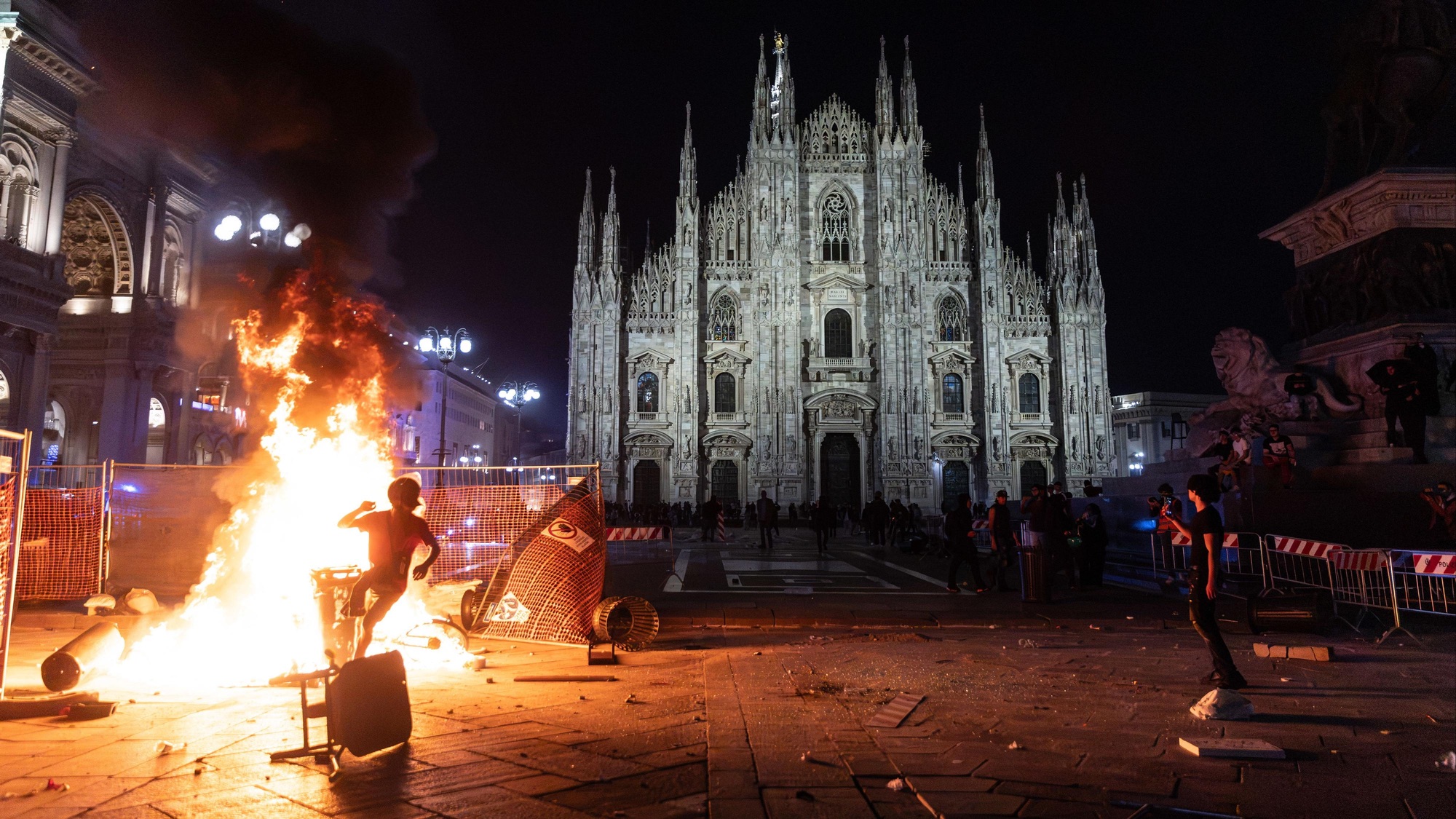
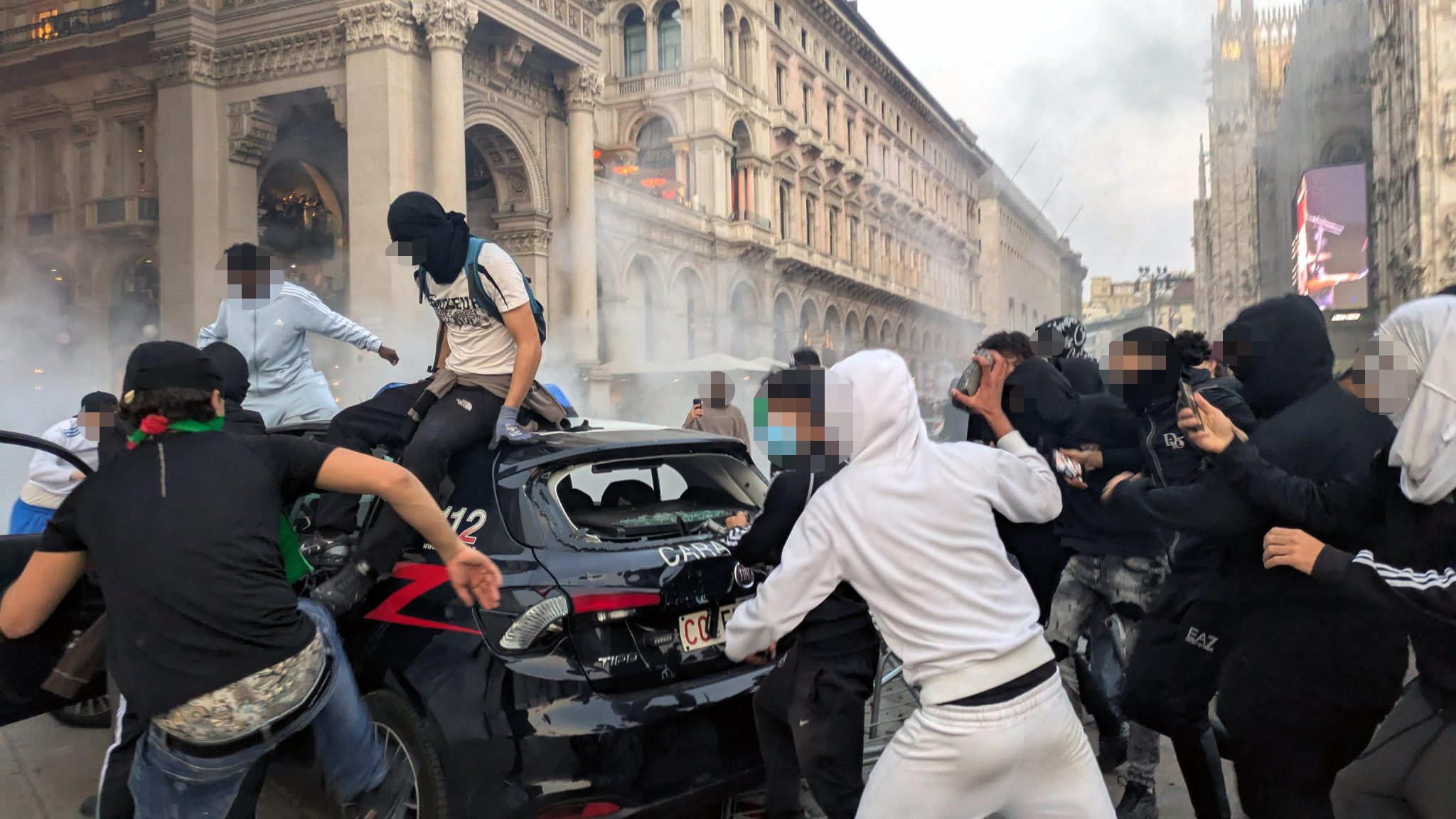
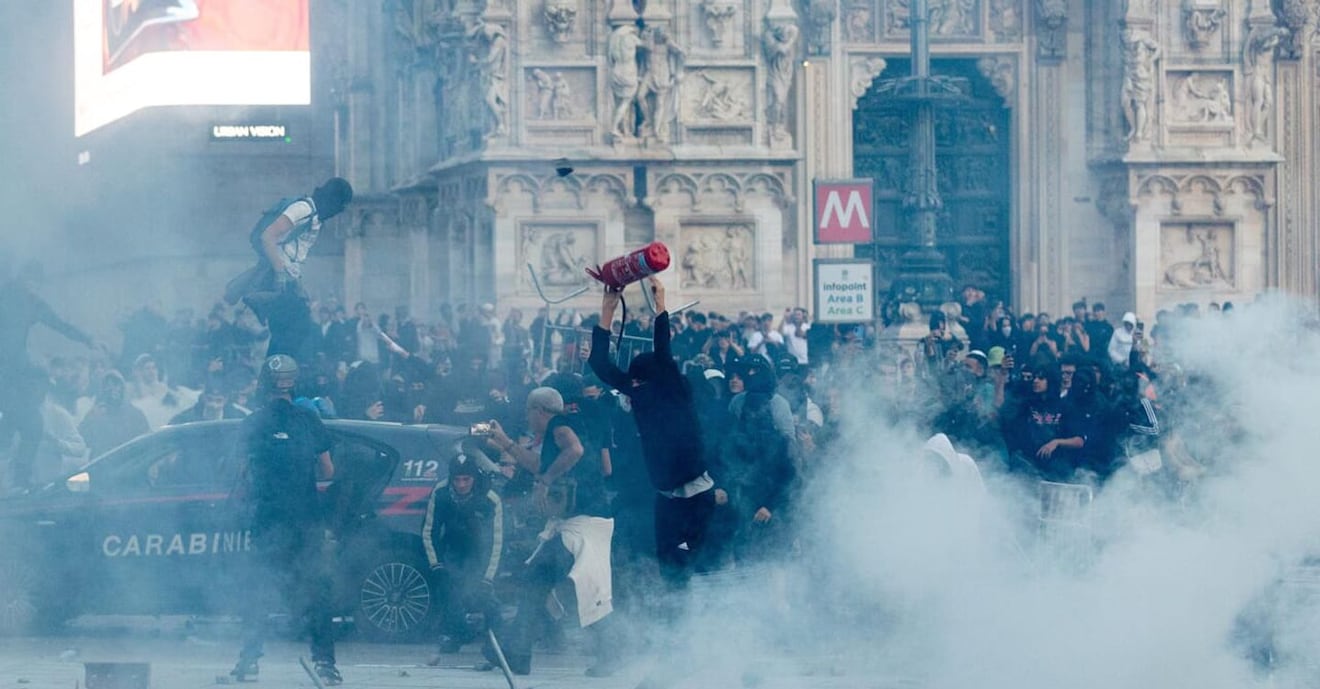
Gleaming atop the dome of Milan Cathedral, the famous golden statue of the Virgin Mary known as the Madonnina looms over a city in revolt. Beneath her gilded gaze, cobblestones fly at police across the Piazza del Duomo [Cathedral Square] through clouds of tear gas. Boys leap onto the hoods of squad cars with cracked windows; they run, they laugh, they attack. Behind the retreating police lines, young girls dance, maneuvering nimbly, preventing the cops from closing the square.
The Italian tricolor flag hangs around the necks of masked young men who have come from all over the world. It’s the best detournement imaginable.1 Flags of Palestine and Albania flutter, firecrackers explode, the red and green bulbs of traffic lights are shattered, trash cans fly. Tourists barricade themselves in luxury shops, cowering in their golden cages.
After an intense round of stone-throwing in the square in front of the Cathedral, the police push us towards Via Torino. From the next street, a column of armored vehicles approaches; we hold our breath in unison. What will happen next?
In that suspended moment, a small figure appears in front of the armored police vehicle. One person. And the vehicle stops.
For a heartbeat, time freezes. A few glances, and it’s decided. All at once, we launch everything into the air—steel barricades, chairs, tables, debris from the streets. The armored column begins a lumbering retreat.
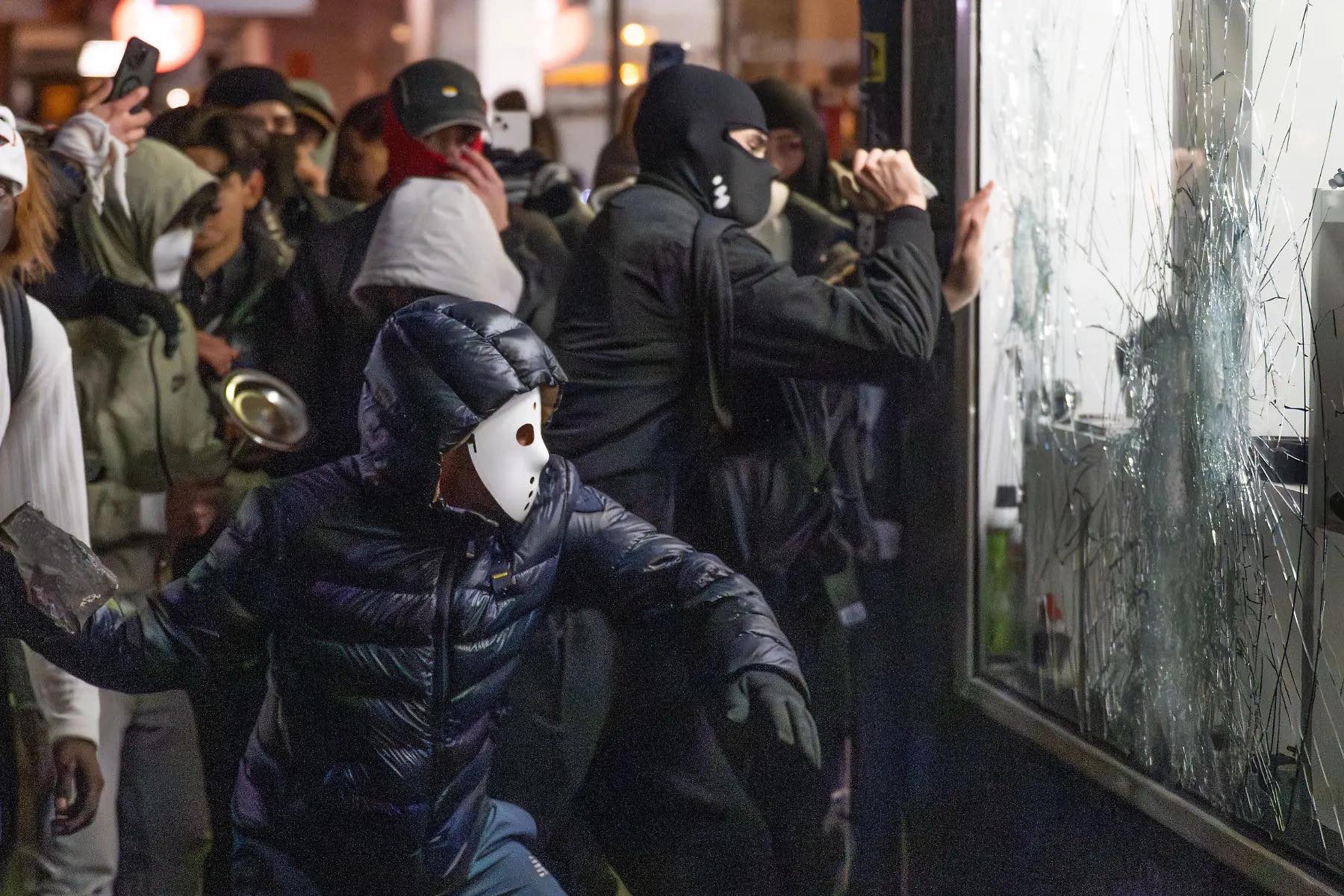
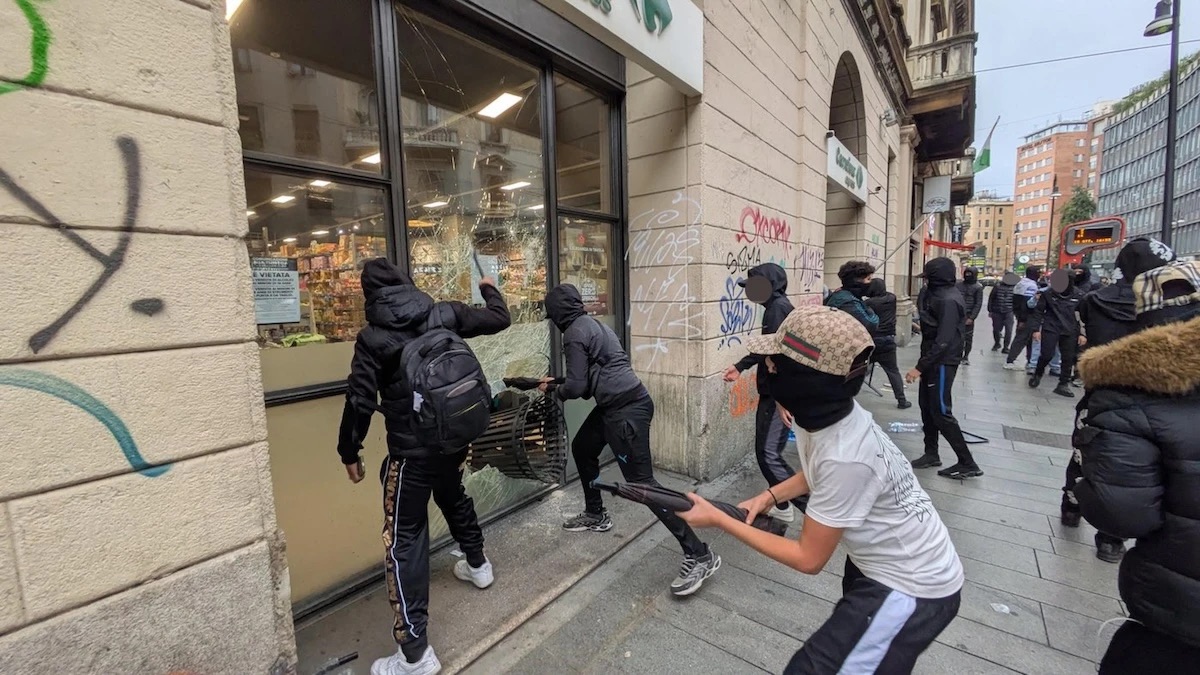
And then in a flash, united as if a single body, we break into a joyful, euphoric sprint. The police retreat. Can it be—have they truly left? They’re gone. Once again, time stops, then the crowd explodes into hugs, shouts, and dances. All around us, the windows are shattering. These temples of consumerism that serve as a meeting point for the young people of the hinterland during the weekends finally take on new life. Freed from behind the shattered windows, the objects within the stores are put to new uses.
Amid the stagnant, unbreathable air of central Milan, something has finally broken open. And everyone can feel the joy that flows out and surges through us.
Clashes with police and attacks on shops continue at the Piazza del Duomo until the evening. Every time the clouds of tear gas force us to retreat from the square, we gather in the side streets and embark on spontaneous, wild marches in small groups. On one of these excursions, a sporting and camping goods store called Decathlon becomes a target. Swarms of young people stream in and out in a whirlwind of enthusiasm, sharing merchandise freely and blending with the crowds of people who remain outside to rejoice.
About thirty people departing from the now-concluded demonstration insult their more courageous and generous peers, instead of stopping to take part or express solidarity. Those in the crowd who stand with the looters shout back defiantly: “So you want to make a ruckus like in France but you complain about Decathlon? That company is super rich, they don’t give a shit! Do you want to make the revolution or what?” We return to the square, leaving behind the small group that hasn’t been transformed by the day’s events.
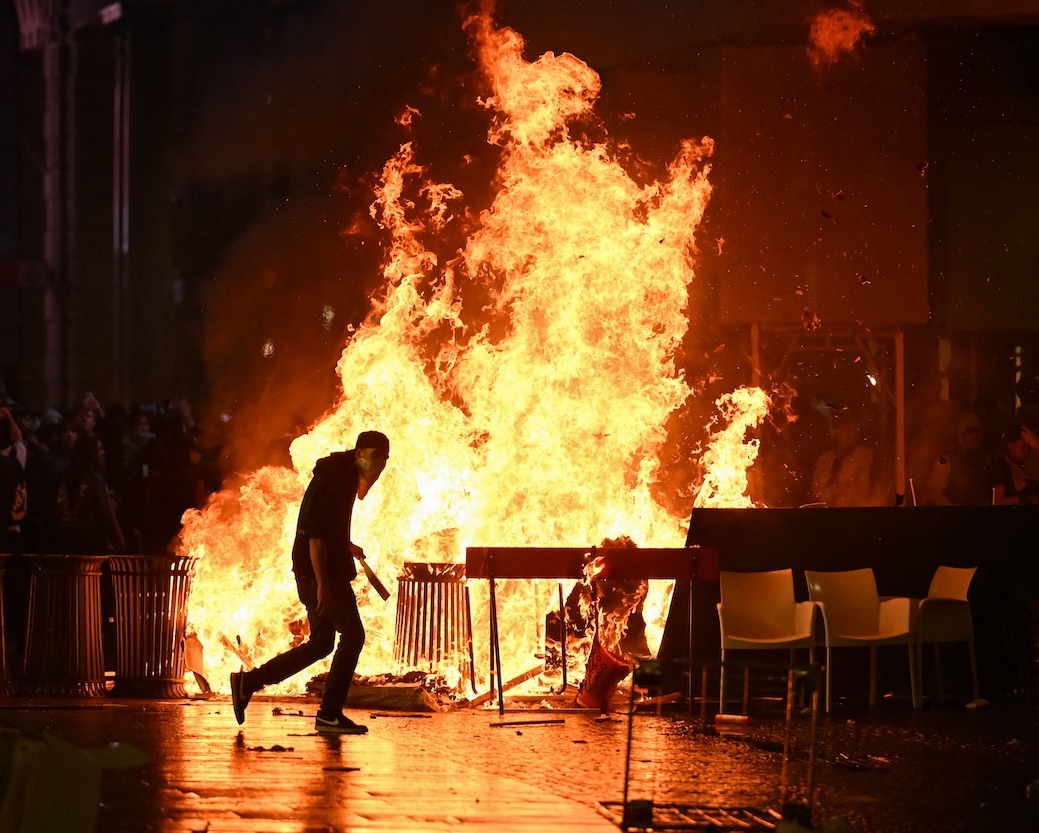
Riots flare up again on the following day. More shops are attacked, windows are destroyed, and goods are reclaimed—this time not only around the Cathedral, but also spreading to other shopping areas of Milan. There are fewer people in the square; on the streets, plainclothes police check IDs and make arrests, while riot cops barge into shops to arrest as many rebels as possible. By the end of the day, alongside the joy and disbelief that the energy has not run out, a high number of arrests have occurred.
The Aftermath
A week later, the government released its tallies from the protests: among 4292 people identified by police, they arrested nine, reported 87, and subjected 371 to preventive detention. Since then, investigations have continued in many Italian cities. To date, police have arrested 36 minors for allegedly participating in the riots of October 17 and 18 in Milan, charging them with property destruction, looting, and resisting a public official. A major trial appears to be on the way.
In the week following the explosive riots of October 17, people organized a solidarity rally outside the San Vittore prison. Organizers in the movement received messages from DIGOS—the plainclothes police force that targets political dissidents, hooligans, and “international terrorism”—threatening to arrest them if they returned to the streets and ordering them not to take part in the unauthorized demonstration outside San Vittore. Nonetheless, the gathering outside the prison attracted a large crowd.
The following week, people also demonstrated outside the juvenile prison, Beccaria. In recent years, this facility has repeatedly made headlines for riots, escape attempts, and brutal repression on the part of the guards, some of whom are being investigated for torture. When we arrived to express solidarity at the prison, the young people inside responded enthusiastically.
Meanwhile, police agencies, local officials, government leaders, opposition parties, and corporate media are using all the energy at their disposal to drum up fear about the maranza. The press uses this disparaging term to stigmatize flashy, boisterous young people, especially those who are the children of North African migrants; in hip hop, the same kids often reclaim the term. This demonization fits a longstanding pattern of targeting the immigrant, the “antagonist,” the young man or unruly woman, the anti-vaxxer or conspiracy theorist.
These categories are nothing but rhetorical devices; they do not correspond to any existing reality. There is no maranza—so we should neither legitimize nor delegitimize them, neither exalt nor criticize. To attempt to do either is to fall into the trap set by the authorities, to grant a material basis to their invented categories. Falling for this provocation only justifies the growing power of the state over us.
Beyond media fantasies of the maranza, who was it that converged in downtown Milan to rebel? In the Piazza del Duomo on October 17, the diverse crowds that appeared were united not only by anger over the cost of living. Above all, they shared the decision to be in the square, to answer a simple call, the determination to be there because the time is now. That is what summoned thousands of people from a wide range of backgrounds. This hunger to assemble in public, echoing the Occupy movement of fifteen years ago, is growing across Europe.
October 17 and 18 marked an inspiring moment in Italy. A new condition of possibility opened up. This generated disorientation and fear for the forces of order, precisely because it represents an opening to the unknown, the emergence of a new force. The state has responded with numerous searches, preventative stops, and arrests.
What will the people of Italy do with this new window of potential? In the aftermath of October 17, activists established an Instagram page titled Movimento 17 ottobre for participants in the day’s events to collaborate on developing a new political language, a new lexicon of unruly practices.
On October 24, many protesters returned to the streets, hoping to find their way back to the Piazza del Duomo. Police responded by establishing widespread control checkpoints at train stations in the outlying regions and at every metro stop near the city center or shopping streets. The Folgore, an Italian Army airborne unit infamous for its fascist sympathies, arrived to protect the Madonnina. They lined up in front of shop windows, patrolled the streets, and parked their tanks in the Piazza del Duomo. In the early afternoon of October 24, authorities in Milan arrested Youssef Sihed, a Palestinian solidarity activist accused of managing the “Movimento 17/10” page.
Despite lacking a permit to protest, a student march still set off from the city center. Meanwhile, another spontaneous demonstration started from a square, where the Association of Palestinians in Italy had gathered. The two marches converged and the groups joined forces. After a week of relentless media terrorism, it was heartening to be together with so many people in the streets. Still, the march lacked the force to exert much control over the situation. In the end, the police managed to drive the demonstrators far from the city center.
The authorities released Youssef Sihed from prison a few days later because the investigating judge did not validate the arrest.
On October 30, a general strike took place, with tens of thousands taking the streets in dozens of cities. However, the day’s events remained contained, lacking the militant energy of October 17.
Although it has not become a movement, the explosive rebellion of October 17 remains—questioning us, reassuring us, and encouraging us. In the days since then, we have debated the influence of the unrest in France, the impact of social media and the power of memes, class anger and the desire to reclaim goods, and much more.
All these factors contributed to the events, but beyond all of them, there remains another fundamental element that produced the alchemy of the square on the 17th. This element completes the magic formula: the electric presence of our bodies together. Elsa Morante, writing in The World Saved by Kids about the revolutionary youth generation of 1968 in Italy, lamented, “After the theft of bodies, there is nothing left but solitude.” On October 17, there was no solitude, because we were present together. Under the Madonnina, our bodies converged at the center of the metropolis, and we felt each other, alive, together.
Further Reading
- Basic Banalities Concerning the January 31 Demonstration in Turin—About the emergence of a new wave of youth resistance in Italy in 2025 and early 2026
-
Détournement, a term used by the Situationist International, describes the reappropriation and overturning of concepts, such as the “subvertisements” of Adbusters. ↩