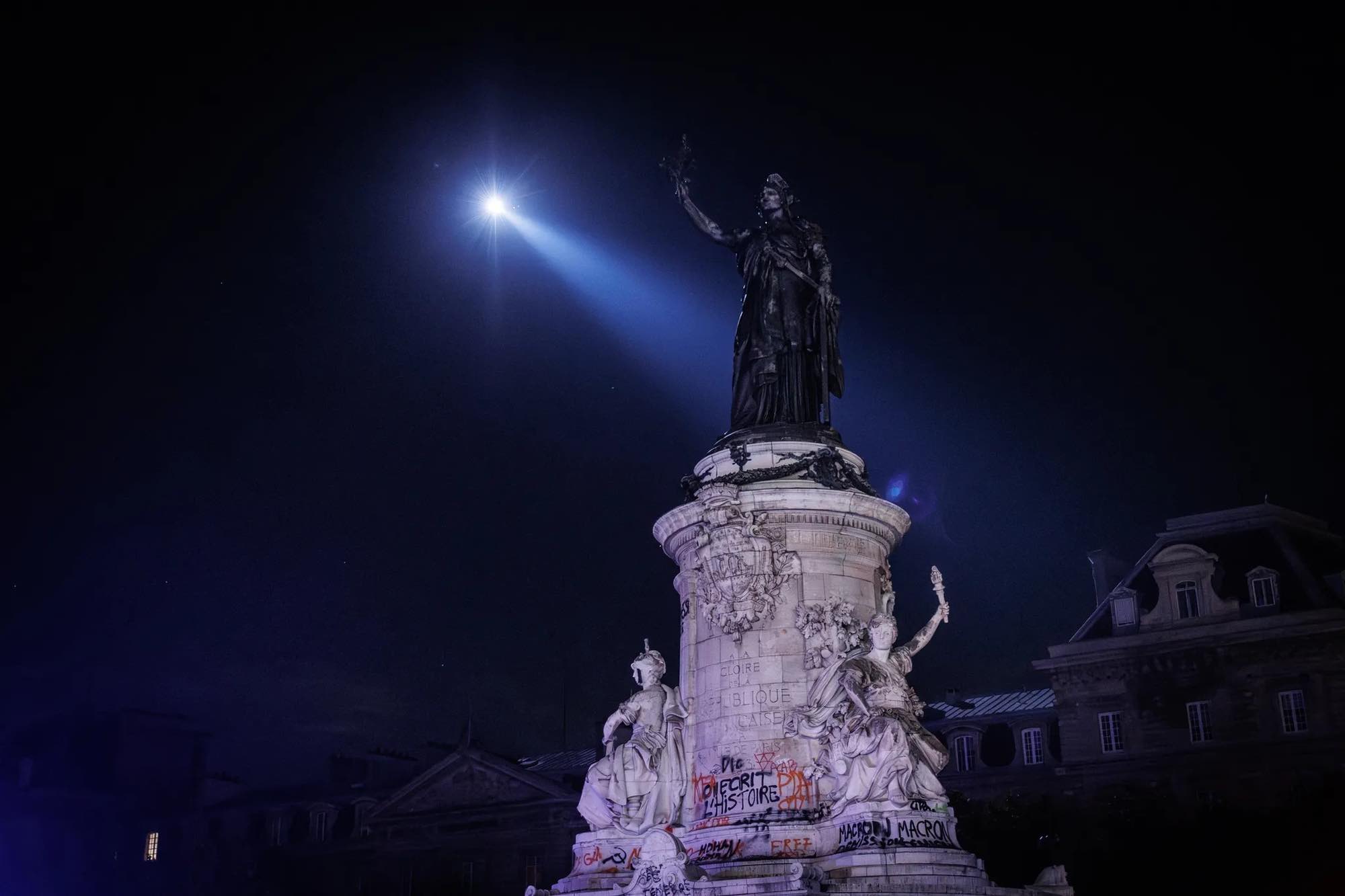
Over the past month, France has erupted in a nationwide rebellion that has shaken the ruling order to its core. As politicians of all stripes focus on polishing their brand image for the next presidential election in May 2027, high school students have organized on a grassroots level. Through occupations, blockades, and street protests, they have taken a stand against both the deplorable conditions of their schools today and the menacing future that looms ahead of them. They took France and the entire world by surprise with their determined mass resistance and their courage in confronting the police forces sent to repress them.
After weeks of daily actions and nationwide demonstrations, leading to an unprecedented wave of arrests targeting rebellious youth, the Macron government was reaching a political impasse. It desperately tried to buy time by opening dialogue with some student organizations, in hopes of blunting the force of the movement until the upcoming school break slowed its momentum.
However, the authorities had not anticipated several developments. First, the students multiplied their force by joining the national call to take the streets on Saturday, October 17 to reignite the Yellow Vests movement, the popular mobilization against high gas prices and government austerity policies that emerged in 2018. Second, anger over the intense police violence of the previous weeks drew even more people in the streets. Third and most dramatically, the day’s protests snowballed into an insurrectionary situation that surpassed what we experienced eight years ago during the height of the Yellow Vests struggle.
This new wave of collective rage that swept over the cities of France last week has plunged the current government into a deeper crisis. Politicians scrambled to capitalize on the upheavals, while authorities responded by implementing more authoritarian policies on a national scale. In the following article, we describe how the dramatic events around October 17 unfolded, analyzing their significance and reflecting on what is at stake.
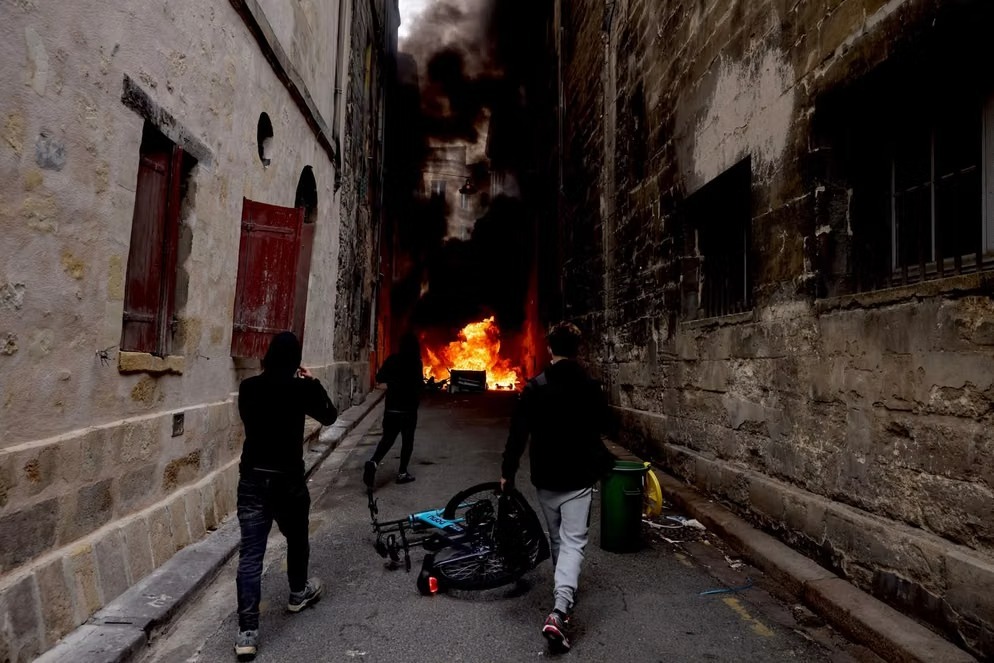
Burning barricades blocking a narrow street in the historical part of downtown Bordeaux (October 17.)
Glowing Embers of Discontent
In 2018, the Yellow Vest movement emerged into the French political landscape seemingly out of nowhere. This grassroots wave of protests formed a reaction against rising gas prices and worsening living conditions among the country’s lower and middle classes. After decades of economic crises, inflation, and harsh neoliberal austerity policies, a portion of the population was feeling isolated, disenfranchised, and abandoned. The capitalist dream of ease and opulence that successive governments had promoted was turning into a living nightmare for a growing number of individuals. The politically diverse movement, named after the fluorescent emergency vests drivers were required to carry in their vehicles, made visible the ongoing economic emergency that gripped more and more people across France.
Due to its open-ended form, the Yellow Vests initially attracted populists from the left and the right and autonomous participants with a range of grievances against the ruling order. From the beginning, an internal struggle unfolded within the movement as radical participants confronted far-right and fascist factions and attempted to prevent cooptation by reactionaries. Over time, the Yellow Vest movement gradually shifted to embrace more anti-capitalist and anti-state perspectives.
Since the initial wave of Yellow Vest protests died down in 2020, the economic situation in France has worsened. The gap between rich and poor has continued to widen, while the Macron government accelerated its dismantling of public services. International conflicts from Ukraine to Iran have further impacted the French economy, worsening inflation and driving up prices on essential goods, energy, and gas.
It is no surprise that people facing such economic pressure would take to the streets to express their discontent. And what better way to threaten the current ruling order than to bring the Yellow Vest movement back from the dead?
It is difficult to know the exact source of this proposal, which began to spread on social media platforms such as Tik Tok and Instagram in September and rapidly went viral. However, veterans from the Yellow Vest struggle along with radical activists, leftist organizations, and student groups alike reposted this call on their own platforms. Unlike the more open-ended participation in the initial swell of populist rage in 2018, this combination of forces left no space for the far-right to try to infiltrate and co-opt this emerging movement.
These groups announced October 17 as a nationwide day of mobilization against the rising cost of living. In the days leading up to the demonstrations, the government remained unsure about what to expect and how to handle the upcoming demonstrations. Focused on defusing the student crisis via democratic tricks and judicial repression, they failed to gauge the looming popular anger that was rising.
Several student organizations issued statements online confirming that they would join the Yellow Vests during the day of action to broaden the base of their weeks-long struggle. Similarly, a range of leftist political parties and organizations called on their supporters to flood the streets to protest the economic situation and the planned budget cuts announced several days prior. On October 1, Prime Minister Sébastien Lecornu presented the government’s 2027 budget, which proposed to reduce public spending by €54 billion, including cuts to retirement pensions, family pensions, and state workers’ wages. If approved, this budget would plunge the French populace into even harsher austerity than we are already experiencing.
Nonetheless, the authorities seemed to have not understood the explosive political situation they faced, nor did they identify what was at stake. Did they really fail to see how the extreme violence students experienced at the hands of police over the previous weeks would provoke outrage and spur people to fight back? Did they really think that we would continue to silently bow down in front of their decisions as they made our lives more miserable day after day?
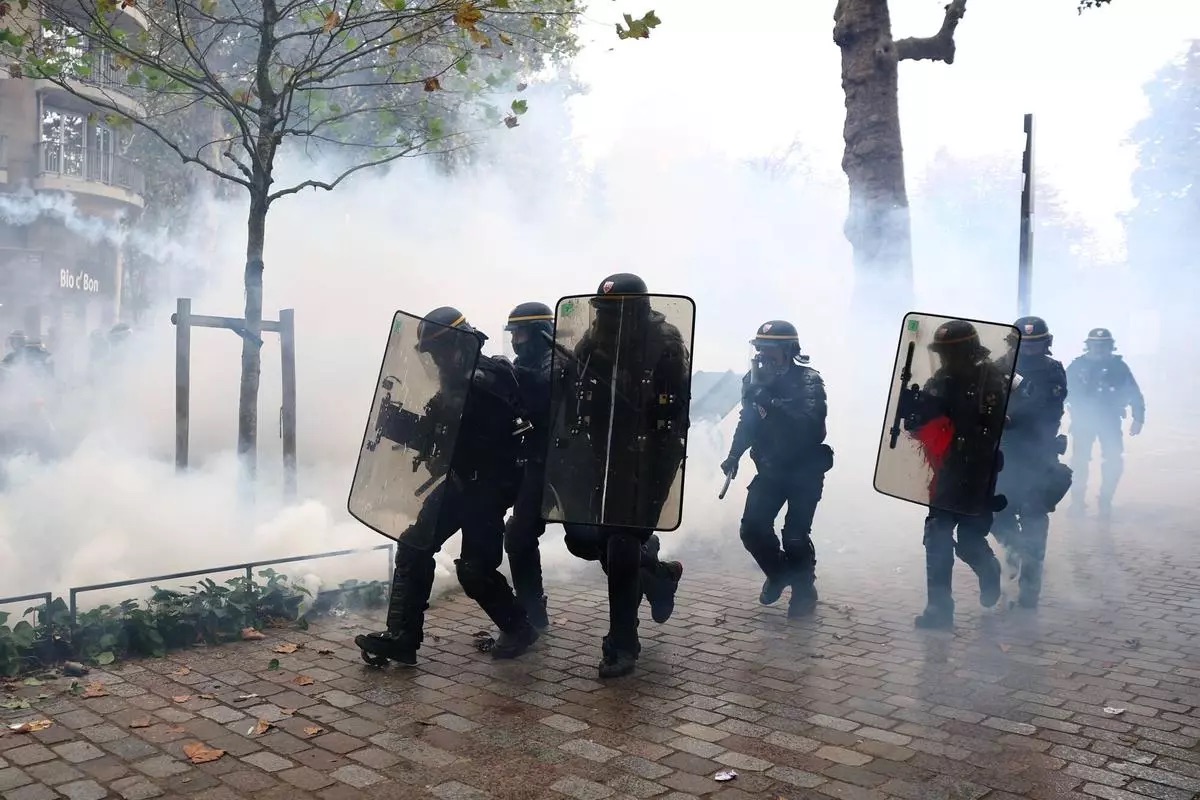
Police forces charging at protesters in the streets of Lille (October 17).
Already weakened by the student mobilization, the government did not have enough time to prepare properly to fight on another front. As a result, their clumsy and erratic response mirrored their handling of the student unrest over the past month.
The Paris Police Prefecture anticipated that between 20,000 and 40,000 protesters would converge in the streets of the French capital city on October 17. Fearing potential violence and public disorder, they decided to cancel the itinerary of the demonstration organized by university students. This march had intended to link Place de la République with Place de la Concorde, near to many symbols of power such as the Assemblée Nationale (the National Assembly) and the Palais de l’Élysée (the Presidential Palace). Instead, authorities allowed the demonstration to connect Place de la République with Place de la Nation. Meanwhile, a second demonstration organized by a revived Yellow Vest Movement and trade unions was also supposed to connect Place de l’Opéra with Place de la Bastille.
While Place de la République and Place de la Bastille are the usual gathering areas for social movements and demonstrations in Paris, the decision of the organizers to plan routes that would allow people to reach areas such as Place de la Concorde and Place de l’Opéra presented a clear message of defiance to authorities. These areas are located within some of the wealthiest and most tourist-heavy districts in Paris and contain numerous official buildings and symbols of capitalism and state power for protesters to target.
Before the day of action, Interior Minister Laurent Nuñez announced that to maintain “peace and order” in the streets, polices forces would be allowed to use stun grenades. Only a few days earlier, following the horrific permanent injury of a teenager during clashes with police forces, the government announced that the use of these specific grenades against young protesters would be suspended until further notice. However, citing the involvement of other demographics of protesters in the upcoming actions, authorities revised their law enforcement strategy by reauthorizing the use of these weapons, voluntarily turning a blind eye to the fact that students would be heavily represented among the ranks of demonstrators that day.
Such announcements form part of a strategy to instill fear among potential demonstrators and discourage individuals from taking the streets. Yet the government’s efforts to intimidate the movements failed, and popular determination remained intact. All eyes turned to the streets of France as October 17 approached—and soon the government would have to face its own worst fears.
A Contagious Rage
October 17 saw actions of unprecedented number and intensity breaking out all over France. Many observers, including politicians, described scenes of chaos that surpassed the most memorable riots of the Yellow Vest movement years before.
As of this writing, it remains difficult to provide a full account of all of the cities that experienced the fury of this new Yellow Vest storm or to offer a comprehensive list of the actions that took place that day. However, government and media sources acknowledged at least 110 locations throughout France that were impacted by protests on October 17. These ranged from peaceful occupations of highway roundabouts to attacks against police, government, and corporate targets, encompassing an extraordinary range of tactics.
The following selection of actions, while far from exhaustive, illustrates the level of intensity of the day’s protests. The events of October 17 have been widely reported and discussed. Nevertheless, actions speak louder than words, and the rioters that unleashed hell in the streets offer living proof of our own agency to take back control of our lives and our future.
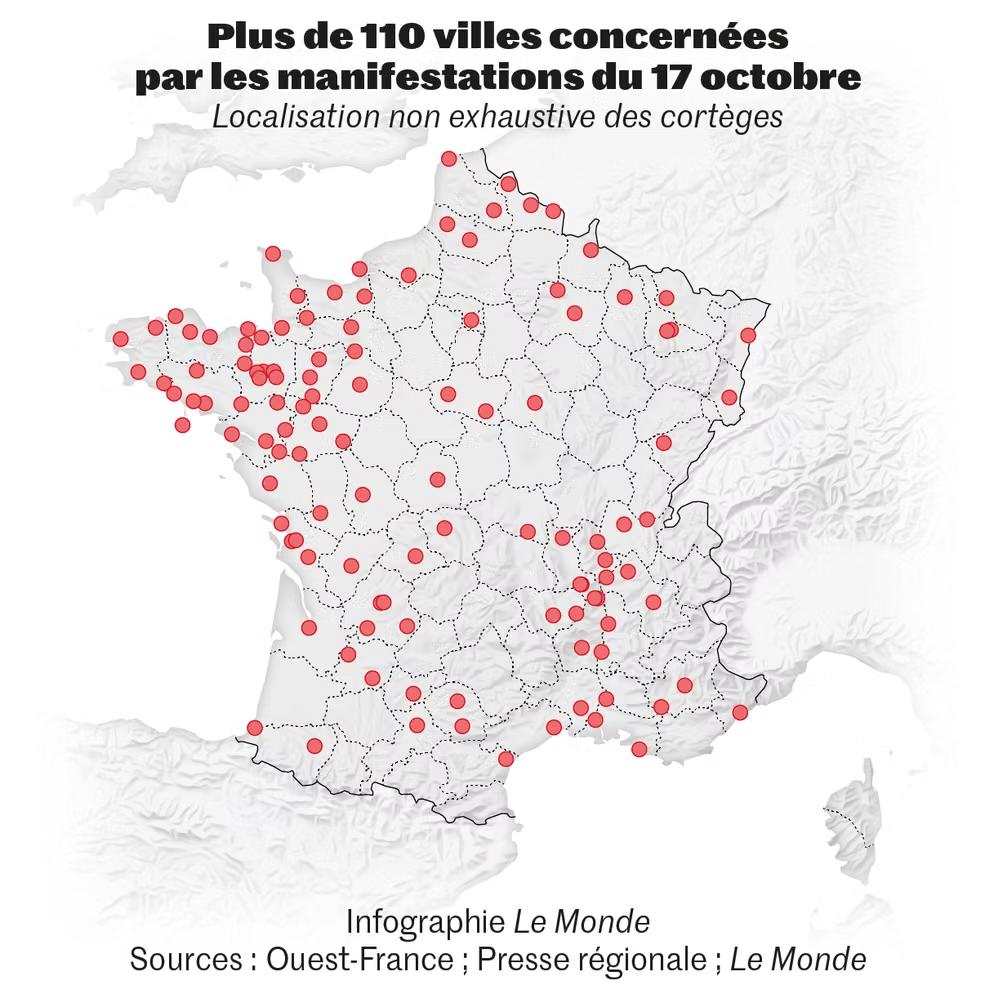
A map of France showing a partial list of cities where actions took place on October 17 as the Yellow Vest movement surged back to life.
Reports from Paris
Early in the morning, we learned that any gathering in the Champs-Élysées area was strictly forbidden. The legacy of fear in this wealthy district still remains strong years after the riots of the Yellow Vest era. Authorities also decided at the last minute to cancel the original itinerary of the afternoon demonstration. Instead of departing from Place de la Bastille, people would have to gather at Place de la République before marching through the northern districts of Paris towards Place de Clichy. By imposing this new route, authorities aimed to push protesters further away from the wealthiest districts of Paris and its symbols of power.
The morning began with a coordinated attack by around one hundred protesters against the headquarters of the television channel CNews. The demonstrators threw multiple projectiles at the building, breaking some windows, before dispersing as police forces arrived. Since its purchase by far-right billionaire Vincent Bolloré in 2016, the channel has become the major platform on French television for conservative, reactionary, and fascist ideologies. Today, CNews has become one of the country’s most viewed 24-hour news channels, playing a critical role in enabling the surge of the National Rally party of Marine Le Pen and normalizing its racist ideas within mainstream political debate. The action drew attention to the central role of corporate media in manipulating popular opinion and spreading harmful political agendas.
Before midday, authorities were already reporting multiple unauthorized gatherings in different areas of Paris. Some attempted to get as close as possible to the Palais de l’Élysée before being pushed back by police units ordered to defend the seats of power. Reusing a strategy that proved effective during the Yellow Vest movement of 2018, these groups refused to follow a specific planned route, understanding that speed, spontaneity, and freedom of movement remain critical assets during street confrontations. BRAV-M motorized police units took charge of stopping the progression of these unruly groups. Their response followed a specific pattern: arriving rapidly on site and reacting as quickly as possible to attack protesters and disperse them with tear gas, stun grenades, or rubber bullets. Their targets then retreated and regrouped elsewhere. This cat-and-mouse game between demonstrators and police would continue all day long, punctuated by moments of conflict at fixed points.
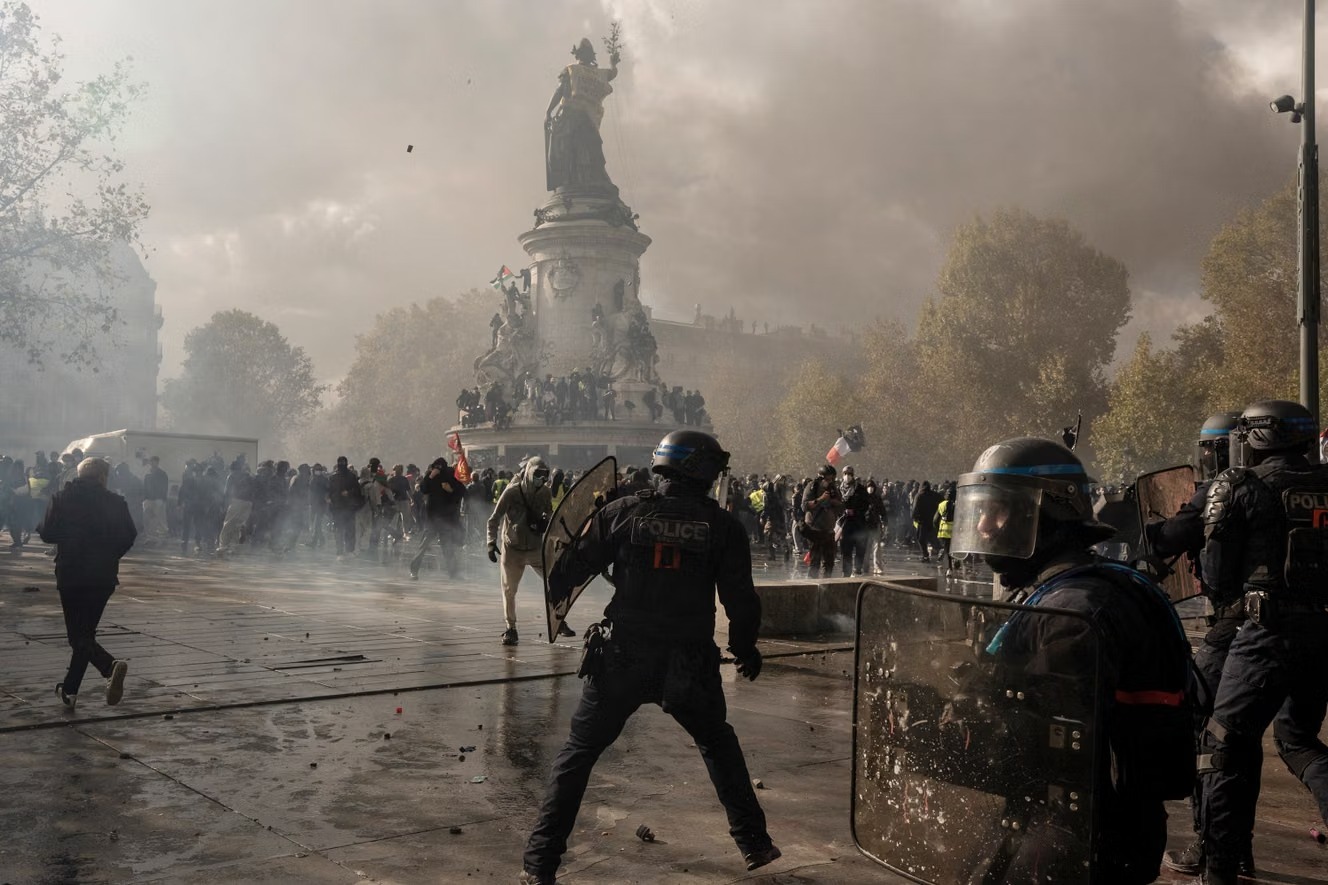
Intense riots unfolded at Place de la République on October 17, after law enforcement officers kettled the demonstrators before the official departure of the afternoon procession.
On the other side of Paris, people were already gathering at Place de la République before the official departure time of the authorized afternoon demonstration. The area was packed and police forces were also present on site, controlling access to the square in an effort to contain the crowd. Tensions increased rapidly, and clashes soon erupted between protesters and the agents of “peace and order.” Taking advantage of the layout of this main square, law enforcement successfully kettled the demonstration and blanketed the square with thick clouds of tear gas on multiple occasions. In response, crowds surged back and forth, as demonstrators fled the irritating gas while rioters counterattacked with projectiles thrown at police lines. At some point during these confrontations, some rebels set a car on fire.
Place de la République remained under police lockdown. Large crowds continued to arrive near the square but were prevented from joining the gathering. Soon, thousands of determined Yellow Vesters, students, activists, families, and rioters were surrounding the square, occupying the main boulevards and nearby streets behind police lines. Protesters seized the opportunity to launch different wildcat marches that set out from République in multiple directions. During these joyful wanderings, massive property destruction and looting took place. Small groups of highly motivated individuals attacked many kinds of stores, enjoying the simple pleasure of getting everything they wanted for free—a feeling long forgotten within our consumer capitalist society, where everything has a price. In some areas, looting and property destruction occurred on such a wide scale that not a single storefront remained intact.
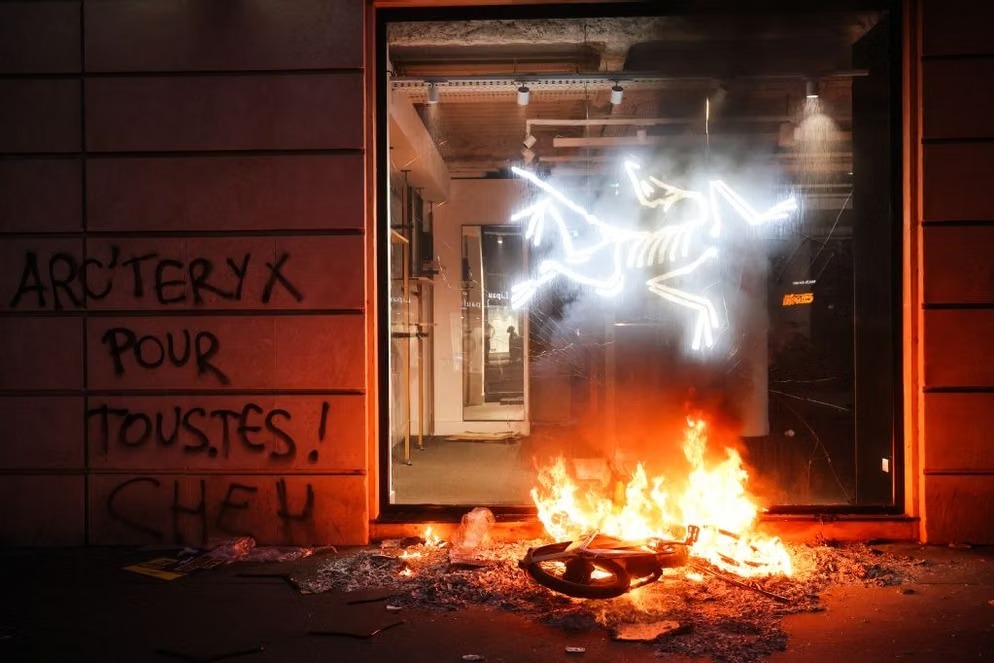
Expensive clothing stores were targeted during the riots that spread throughout France on October 17. This picture was taken in Paris and the graffiti reads: “Arc’teryx for all!”
Riots spread throughout the city all afternoon. Thick clouds of smoke from flaming barricades billowed above the Parisian skyline, punctuated by explosions from fireworks or stun grenades echoing through the streets of numerous districts. Intense confrontations with police forces took place in the districts of République, Bastille, Châtelet-Les Halles, Madeleine, and Le Marais, among others. The outnumbered police forces were clearly overwhelmed by the insurrectionary situation unfolding the streets: burning barricades by the hundreds, cars set ablaze, numerous attacks on symbols of capitalism, and more. On multiple occasions, officers had no option but to retreat from confrontations as angry rioters got the upper hand and took control of entire streets. These moments showed plainly the powerlessness of the authorities to maintain their “peace and order” in the streets of France’s capital city.
As the sun set, demonstrators attempted to converge on the Champs-Élysées, building more barricades and confronting police forces in the neighboring streets. The deep darkness of the autumn night proved the perfect ally for rioters who wanted to continue raging until the early hours. Mobile groups continued to loot stores regardless of what they were selling: clothing, electronics, video games, pharmacy, tobacco, and other outlets all saw their goods redistributed outside the logic of the market. In some instances, multiple attacks targeted single stores on different occasions. Police forces continued to chase the remaining protesters throughout the night as the intensity of the upheaval gradually declined.
While some regions of the city saw widespread looting amidst flaming cars and barricades, others saw calmer mobilizations. During the afternoon, as offensive street actions broke out in some areas, other demonstrators joined the official march composed of students and leftist organizations, walking through the northern part of the city in a completely different atmosphere. During this more traditional march, demonstrators did not engage in property destruction or confrontations with police, sometimes remaining unaware that intense riots were happening just a few streets away. Yet the following morning, visible proof of these dual realities lingered in the remains of burned barricades, shattered targets, and looted stores.
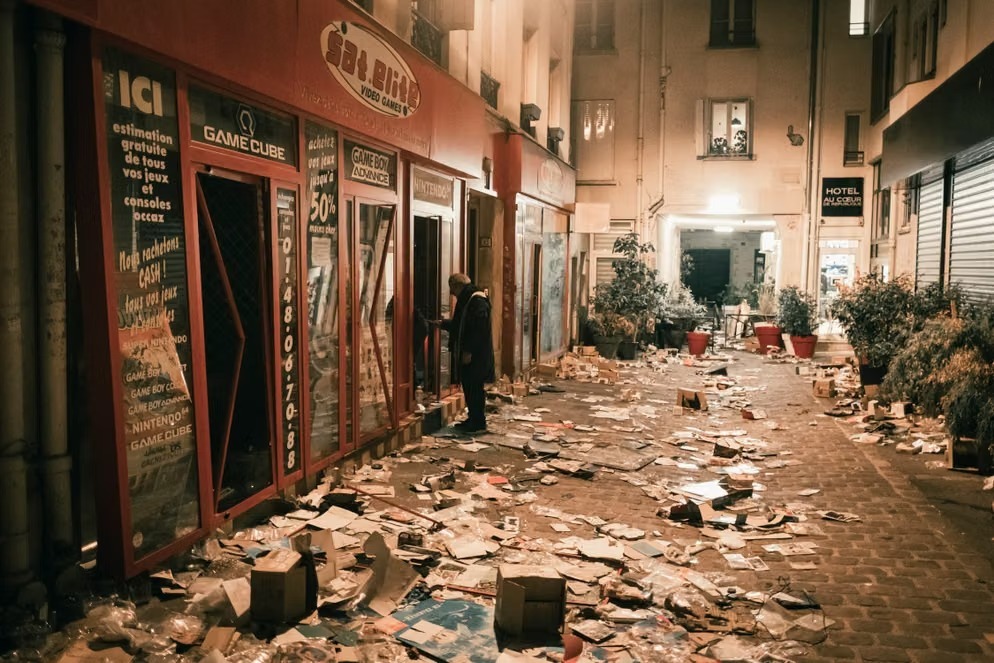
A video-game store looted in Paris (October 17).
Beyond the Capital: An Overview of Resistance
Paris was far from the only city in France where protesters overcame police forces and freely expressed their rage on October 17. In fact, similarly to the Yellow Vest mobilizations years before, some of the most impressive actions of the day took place elsewhere. One of the major strengths of this day of action was its decentralized character, which allowed grassroot forces to gather locally and forced police forces to disperse throughout the entire country. The scarcity of law enforcement in specific cities combined with the unstoppable determination of rioters led to extensive attacks against institutions of power and their symbols.
Here is an overview of highlights from the day’s actions in other French cities:
- In Marseille, confrontations between protesters and police forces began early in the morning and continued all day long. Angry demonstrators succeeded in keeping police forces in check. During the day, crowds attacked at least two police stations, stormed City Hall, and looted and ransacked numerous stores. Local authorities announced that at the height of the riots, some 30,000 individuals were engaging in looting, property destruction, and direct confrontations with law enforcement.
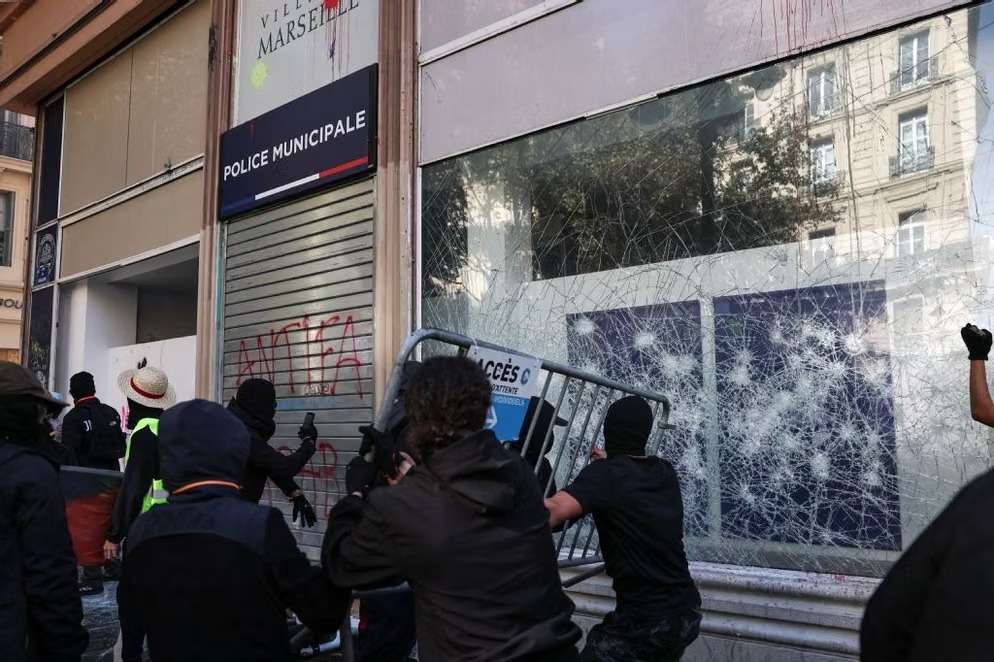
Rioters attacking a police station in Marseille (October 17).
- In Bordeaux, protesters ransacked the Palais de la Bourse, the location of the Chamber of Commerce and Industry and the commercial court. Demonstrators also rampaged through the main shopping street, looting numerous stores and setting a sport retail store on fire after emptying all of its goods. Intense confrontations with police forces took place in front of the City Hall. A riot police vehicle was attacked and burnt. Some protesters also raided the private residence of a local government representative.
By the end of the day, the situation in Bordeaux had gotten so out of control that local authorities received assistance from the RAID, a specialized response unit of the national police. For example, the RAID took part of the assault at the Bataclan during the terror attacks of November 15, 2025.
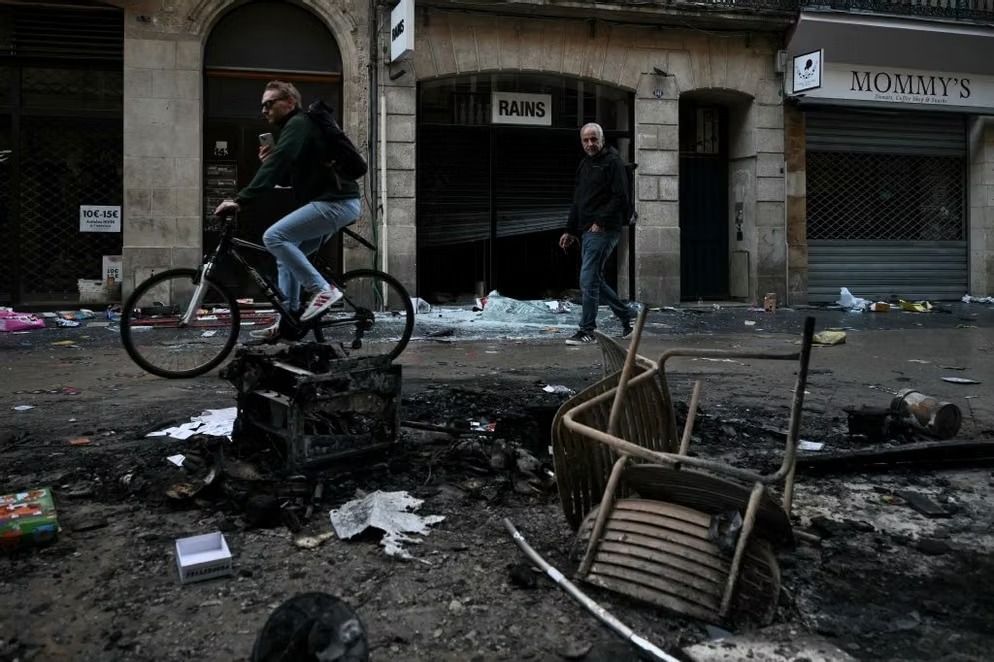
The day after the storm, somewhere in downtown Bordeaux.
- In Nantes, demonstrators experienced brutal police violence even before the departure of the authorized demonstration. Anger against these attacks led to hours of riots in the city. Police units were forced to back down on several occasions, allowing protesters to progressively retake control of the streets. Barricades appeared throughout the streets, the train station was vandalized, and several stores were invaded. At the end of the afternoon, confrontations continued to take place and law enforcement deployed armored vehicles in the streets.
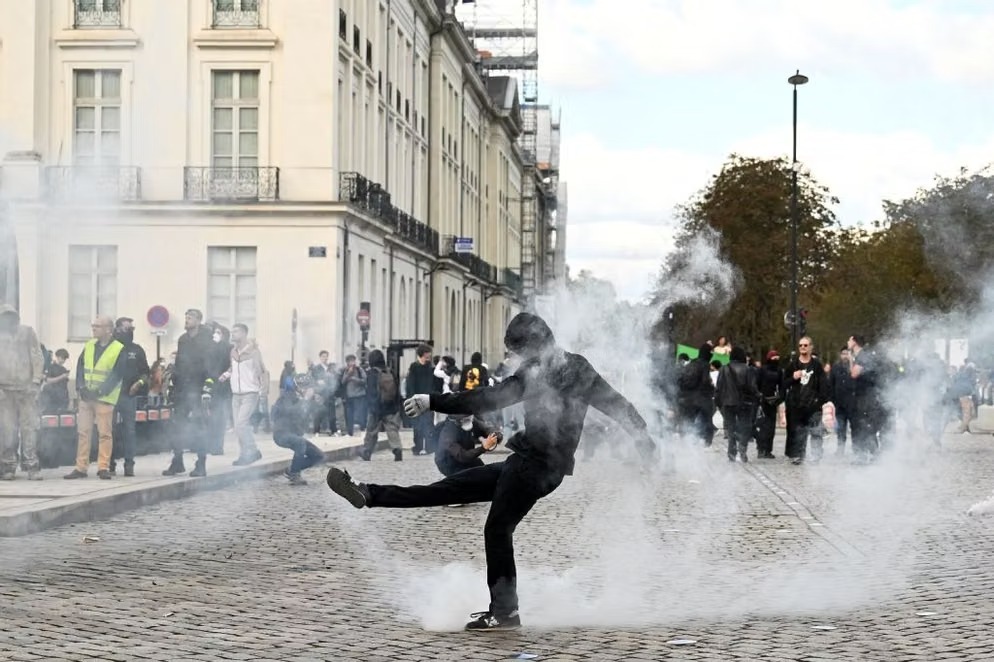
A protester kicking a tear gas canister in Nantes (October 17.)
-
In Rennes, demonstrators started the day with numerous blockades before converging to the main demonstration. Dozens of barricades were set on fire, some construction equipment found along the route was deployed to block the progress of law enforcement, and protesters engaged in various clashes with police. As in other cities, department stores were also looted.
-
In Lyon, protesters let their rage explode. Massive street confrontations with police forces took place in several areas, while rioters looted everything they could. The arson attack on the tourist office at Place Bellecourt exemplified the intensity of the day’s actions.
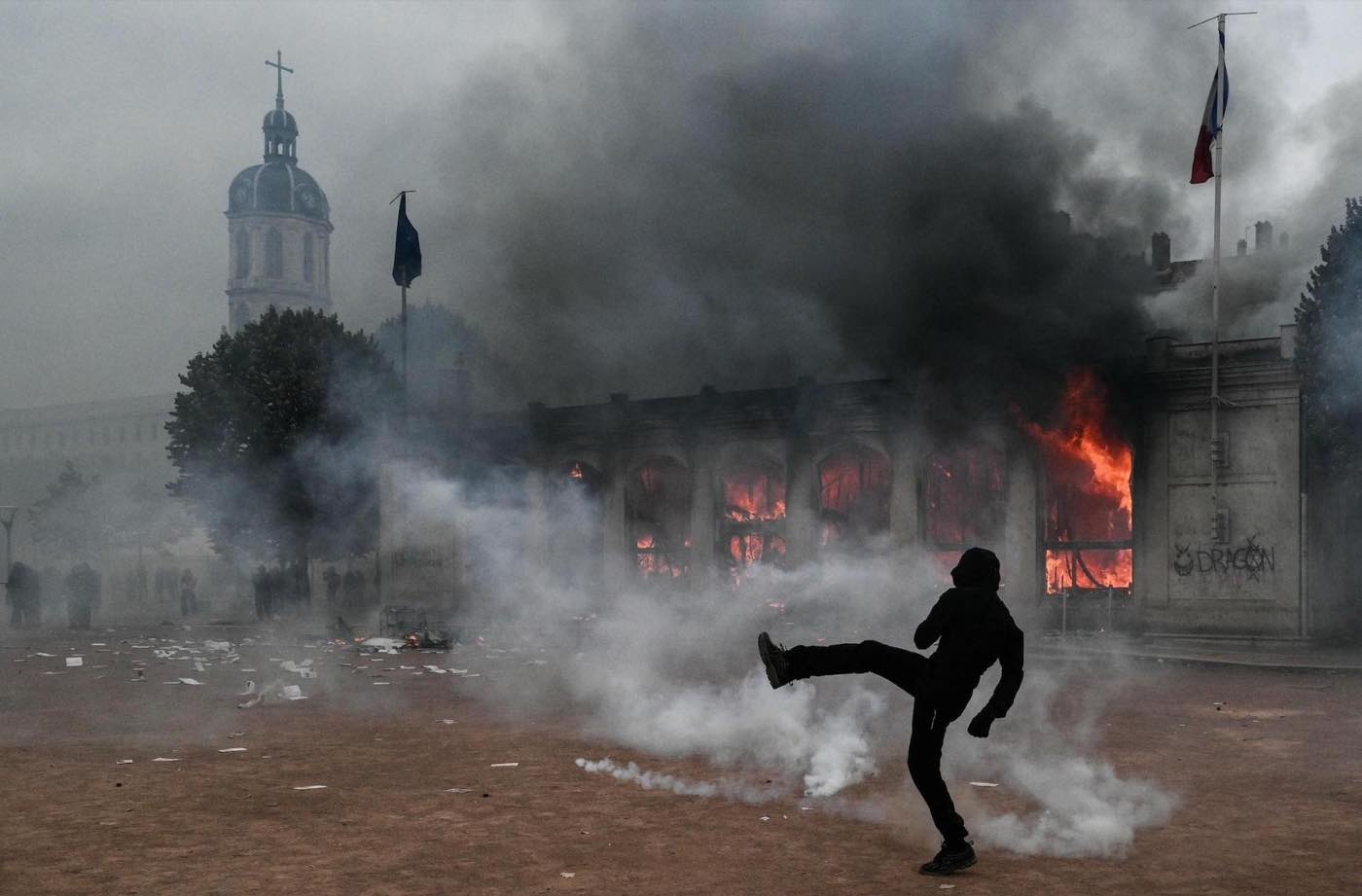
The Lyon tourist office burns to the ground (October 17).
- In Lille, demonstrators attacked several entrances of the City Hall before finally succeeding in breaking in and rampaging through the mayor’s office. A movie theater was also devoured by flames.
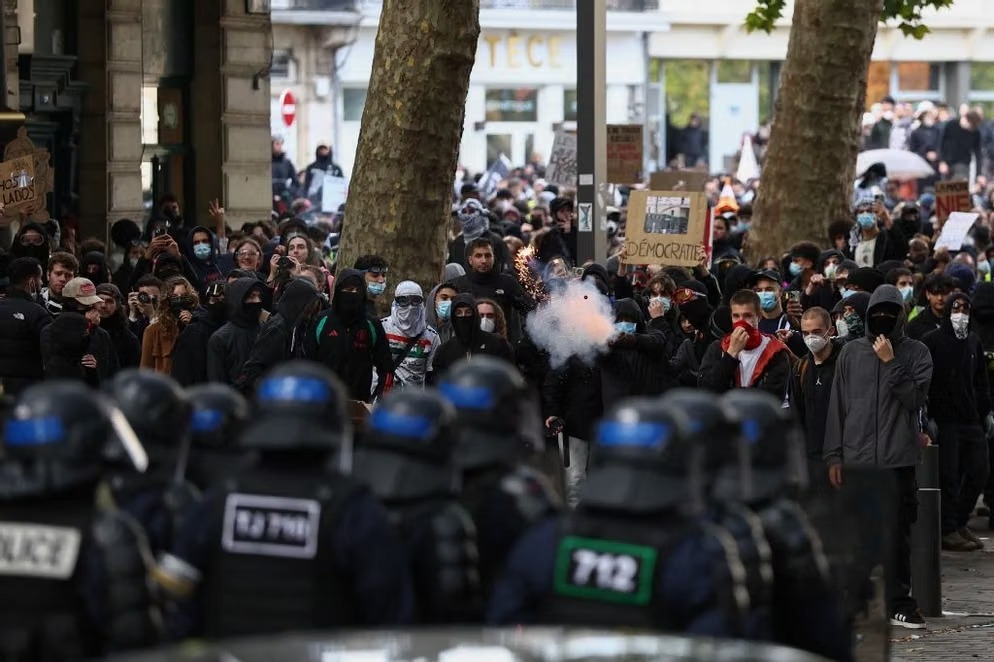
Young protesters confront the real “agents of chaos” in Lille (October 17).
During this nationwide insurrection, protesters relentlessly attacked all kinds of symbols of power, from police stations and prefecture buildings to city halls, in cities such as Caen, Angers, Orléans, Brest, Avignon, and Grenoble, just to name a few. In one of the day’s most spectacular attacks, protesters burned down the city hall of Limoges, which authorities later confirmed is now “largely lost.”
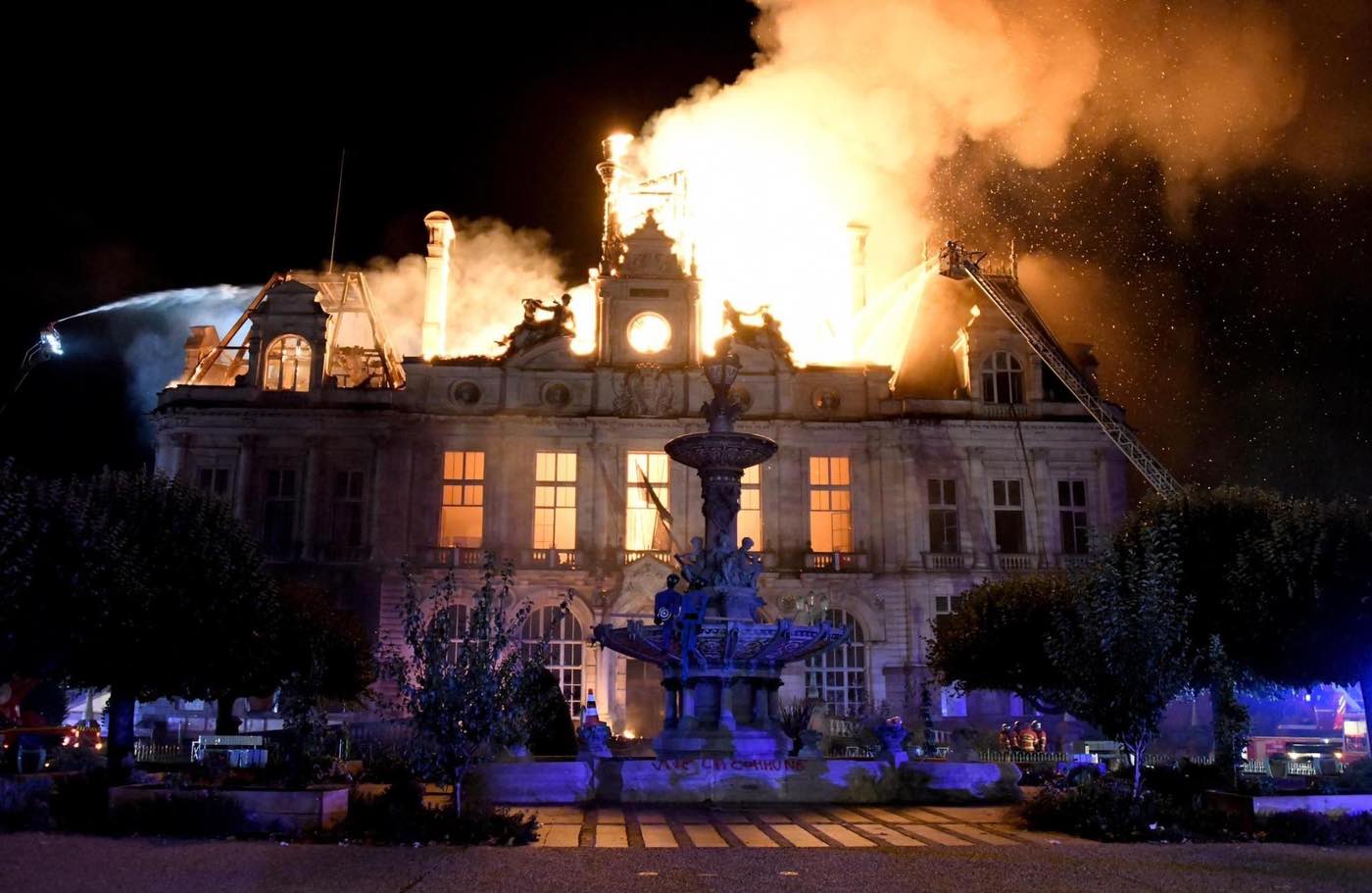
The Limoges City Hall being devoured by flames, (October 17).
Besides the widespread confrontations with police forces in the streets, demonstrators also targeted key infrastructures to disrupt the flow of people and goods. In Montpellier, protesters shut down the train station, while Reims, Chambéry, Toulon, and Tours saw main roads and freeways blocked and gas stations targeted.
Reflections on an Insurrection
The events of October 17 overwhelmed all expectations of both the state and the movement. How did this happen? What does this explosion of insurrectionary energy across the country tell us about the political situation and the movement’s possibilities?
Since the emergence of the first Yellow Vest movement in 2018, its participants have come and gone as its character shifted over time. As noted above, after several months of unrest, the movement gradually evolved towards a more distinctly anti-capitalist approach and focused on active resistance to police violence and government austerity measures. Such political positions, as well as the more openly offensive tactics embraced by its more revolutionary participants, might have scared away some less radical demonstrators.
Nevertheless, Yellow Vesters remained massively present in the streets during other important moments, such as the annual May Day processions and the pension reform strikes of 2023.
Participants in the movement appeared less visibly as a force in the streets during the past few years, as many stopped wearing the symbolic fluorescent emergency vest to preserve anonymity. Nonetheless, they continued to organize on a local scale within groups that remain active to this day. It was exhilarating to see them return in large numbers for this nationwide call, as some played an important role alongside other radicals during street confrontations and riots.
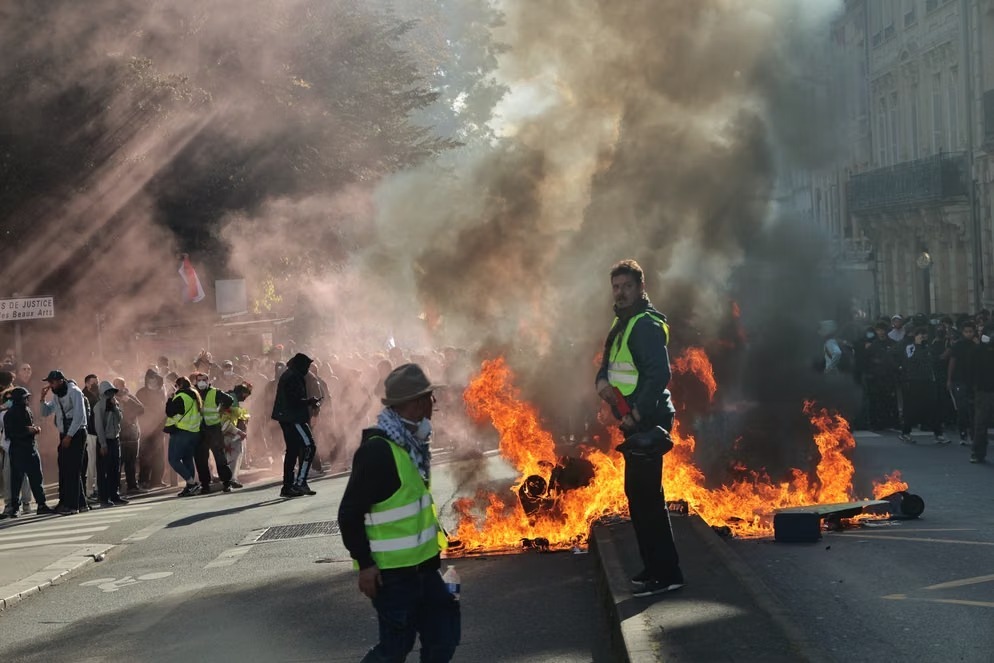
Yellow Vesters in front of a burning barricade, somewhere in Rouen (October 17).
The number and intensity of actions carried out on October 17 was simply overwhelming and amazing. No single explanation can account for why events unfolded as they did, but several factors contributed to the day’s unprecedented explosiveness.
First, it is important to acknowledge that everything that happened on October 17 was already happening during the student unrest, although on a much smaller scale. Several high schools had been vandalized or set ablaze, well-organized groups of teenagers had attacked police forces, and stores had been looted during this month-long mobilization. Protesters had been experimenting with militant tactics that generalized across the country on the day of action when the social forces engaged in the demonstrations broadened.
Moreover, the violent repression that specifically targeted teenagers from les banlieues and other low-income neighborhoods antagonized rebellious youth. The national day of action offered them an ideal opportunity to retaliate and avenge their comrades, even though some of these young rebels usually prefer to stay away from traditional social movements and political appeals.
Additionally, social media played a key role in spreading word about the day of action through different demographics of protesters. It is undeniable that these platforms helped people to organize and prepared them to gather en masse in the streets throughout France. Corporate media have reported on some so-called influencer who went as far as openly urging his followers to take the streets to riot and loot everything, as if in some real-life video game. While such instances serve more as an easy target for official condemnation than a plausible explanation for popular rebellion, the least we can say is that his words didn’t remain unheard.
On October 17, events were able to escalate rapidly due to the overall low number of police forces deployed to contain the waves of protesters present in the streets. Many people were furious and willing to act accordingly. Yellow Vesters, radicals, groups of teenage rioters—everyone wanted to participate in the festivities in one way or another and were determined get their part of the cake. As Mikhail Bakunin rightfully said in 1842: “The passion for destruction is a creative passion, too.”
Finally, amidst this beautiful raging chaos, anarchists, autonomous radicals, and other rebels did their part. Throughout France, we were able to seize the day and effectively attack the ruling order. From the messages left on the walls or in the streets, to the capitalist and corporate symbols targeted, to the multiple attacks against institutional buildings and police stations, the meaning was clear. We reminded those in charge that we are still here, and we will continue to relentlessly attack their world.
What happened on October 17 surpassed our expectations. The energy, determination and intensity unleashed in the streets will continue to inspire us through the challenges ahead. We were able to fight together for hours against police forces, to the point of literally defeating them. We created multiple spaces for other accomplices to develop their agency and engage in their own forms of illegal actions. Most importantly, we were able to show for an entire day that their power is nothing but a sham. It takes only courage and a brick to make it shatter.
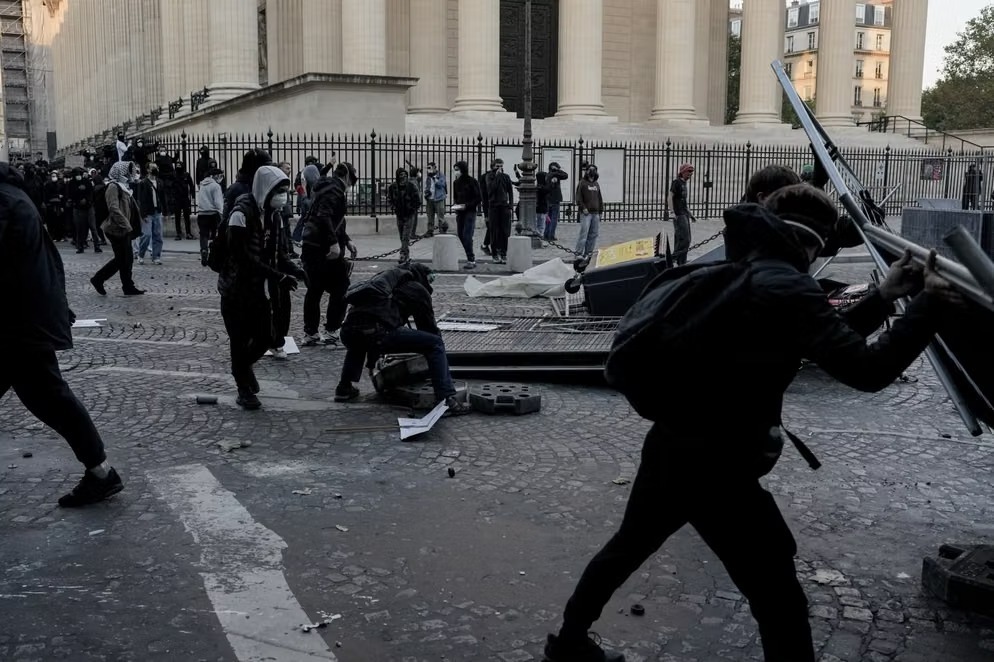
Protesters building a makeshift barricade to protect themselves from police forces at Place de la Madeleine in Paris (October 17).
The Government Reacts
Around 9:00 pm, as riots were still raging across the country, the government began to construct its narrative about the day’s events through statements in the corporate media. President Emmanuel Macron stated that individuals who took part in property destruction and looting would be “prosecuted and punished” and insisted that the country would “stand united against the sowers of chaos who seek only to bring down our institutions.”
In numerous cities, mayors unanimously condemned the acts of violence that took place during demonstrations. Emmanuel Grégoire, the Mayor of Paris and member of the Socialist Party, lamented the “heavy” toll from the violence and the “immense scale” of looting in the capital, with “entire streets” having been “methodically ravaged.”
Indeed, the economic impact of the riots was extraordinary. In the following days, journalists claimed that “the extent of the damage in such a short period of time could be unprecedented,” with about 3,000 stores around the country destroyed, according to official estimates. So far, “the bill is expected to reach as much as 1.2 billion euros,” which could very likely increase if property destruction continues over the coming weeks.
Interior Minister Nuñez announced that 550,000 people had participated in the day’s protests throughout France, including 110,000 in Paris alone. Organizers estimated that between 800,000 and 1 million demonstrators had answered the nationwide call on October 17, 2026. Arrest totals were originally reported as 1,200, with almost 400 in Paris, and climbed to 1,800 the following day, with some sources claiming more than 2,300 arrests. By October 22, reports indicated that at least 2700 individuals were in custody and 217 were in pre-trial detention following the events of October 17.
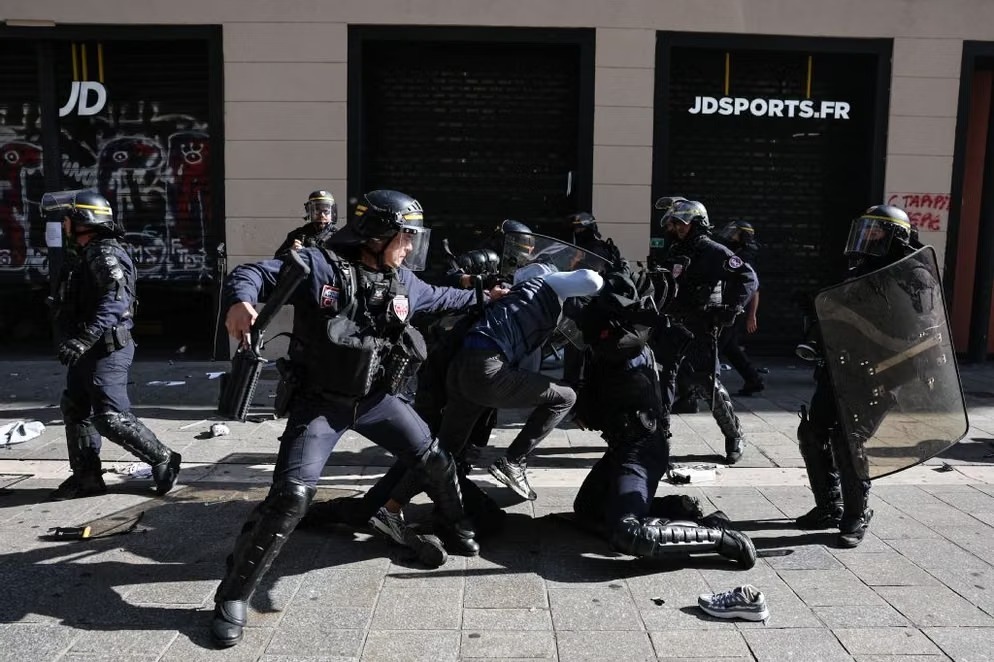
Police forces arresting a protester during riots in Marseille (October 17).
The number of demonstrators injured during confrontations is almost impossible to estimate, with no official way of counting them. However, national media reported that in Saint-Étienne a demonstrator had his hand “blown off” by a grenade. This injury resulted directly from the government’s decision to reintroduce the use of this specific military weapon to repress protesters. Unsurprisingly, the state has more blood on its hands once again.
The Days After
The next morning, the people of France awoke in a haze, witnessing scenes of chaos and devastation in the streets and realizing the level of damages that had resulted from the protests. As usual following days of action, so-called “good Samaritans” and self-righteous citizens decided to help clean up their streets and neighborhoods, actively participating in the process of erasure that the ruling order implements to bring back the illusion of normality.
Owners and employees of stores that experienced lootings or property destructions on the previous day complained to corporate media outlets, using familiar arguments that stigmatized rioters and dissociated them from other demonstrators. They reinforced the narrative that such actions have nothing to do with the “legitimate” demands made by the movement. We see here how the official discourse has become ingrained within a part of the population concerned only with defending its own privileges, even as the political class and economic system the rioters fought to challenge renders those privileges ever more precarious.
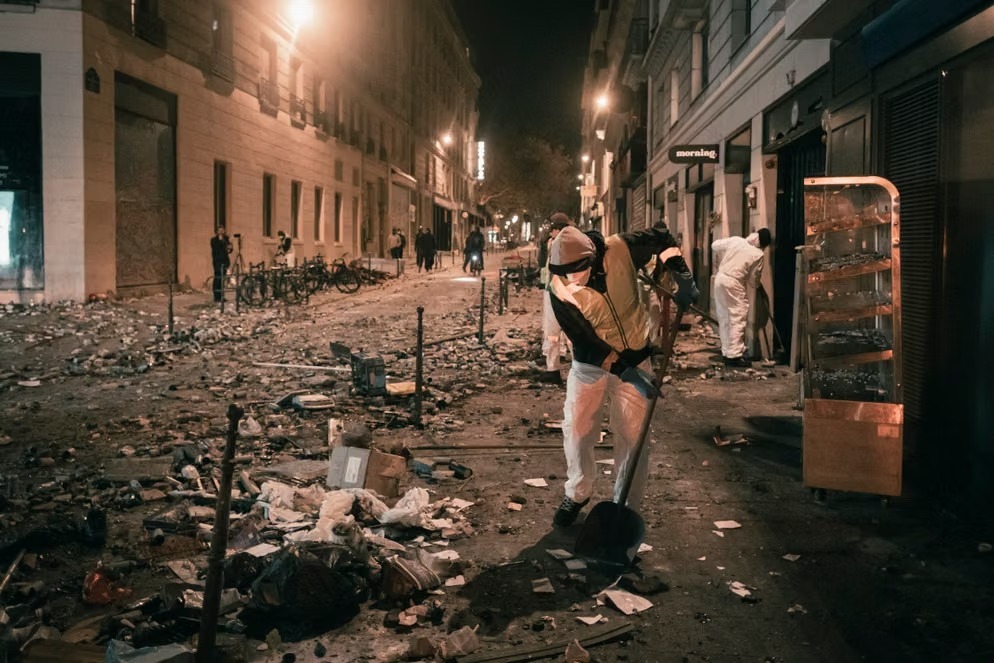
After the riots, city workers and “good Samaritans” cleaned up the streets (Paris, October 18).
The Political Parties Attempt to Capitalize
It took no time on Sunday morning to hear official communiqués from across the political spectrum regarding the riots of the previous day. As the Ministry of the Interior cried about the nearly 1,000 officers injured the previous day, party leaders planning to run for president in the next election moved quickly to turn the events to their advantage. In unison, all sides criticized the Macron government’s handling of the unrest and management of law enforcement. However, their interpretations differed radically depending on their ideological position.
Unsurprisingly, far-right leaders focused on two of their favorite themes: national security and immigration. They emphasized on the government’s failure to maintain social order across the country or to ensure the safety of its “good citizens” and “hard workers” against the “hordes of rioters” who “disrespect and hate this country and want to destroy it by any means necessary.” According to them, radical leftists and lower-class people living in les banlieues bore sole responsibility for the previous day’s violence, proving themselves to be the “enemy within” that must be eliminated. Such rhetoric echoes through the rhetoric of reactionary and fascist political leaders worldwide, exemplified by the image of Donald Trump in the US. In addition, some far-right reactionaries called on the government to implement a state of emergency without delay to restore control over the nation.
Members of the conservative right, centrists, and the liberal left also criticized the government’s law enforcement doctrine. They expressed their worries in terms of public safety and national security and requested investigations to understand how such events were able to unfold. They also reiterated their support for business owners whose property was destroyed and the families of injured officers. Finally, in almost all their statements, they accused La France Insoumise (LFI), the so-called radical left statist parliamentary party, of being co-responsible for—if not fully in control of behind the scenes—the violence in the streets. Indeed, since members of LFI had officially called on supporters to join the mobilizations on October 17, other politicians held them responsible for fomenting the rage in the streets. The Macron government also aligned with this narrative.
In response to these allegations, LFI leaders and other members of the parliamentary “radical left” publicly defended their positions. They attacked the Macron government’s decision to brutally repress any form of resistance in the streets, from the high school students of the previous weeks to the more diverse crowds of protesters present on October 17. They also refused to play the game imposed by journalists who asked them to pick a side between the Republic or rioters. Because they desire to one day hold power in France, LFI and its leader Jean-Luc Mélenchon continue to have an ambiguous political position, supporting protest in general while disavowing its ungovernable expressions. While they always take to the streets during social movement mobilizations, they commonly turn their back on demonstrators who act on their own terms outside of the state’s legal framework.
Throughout several official statements that saturated the corporate media, one concept came back in the political discourse: the “ultra-left.” The newly elected right-wing mayor of Limoges, Guillaume Guérin, emphasized this framework during his press conference following the arson that burned the City Hall to the ground. According to him, this action was the result of well-prepared members of the ultra-left who knew exactly where to attack the building.
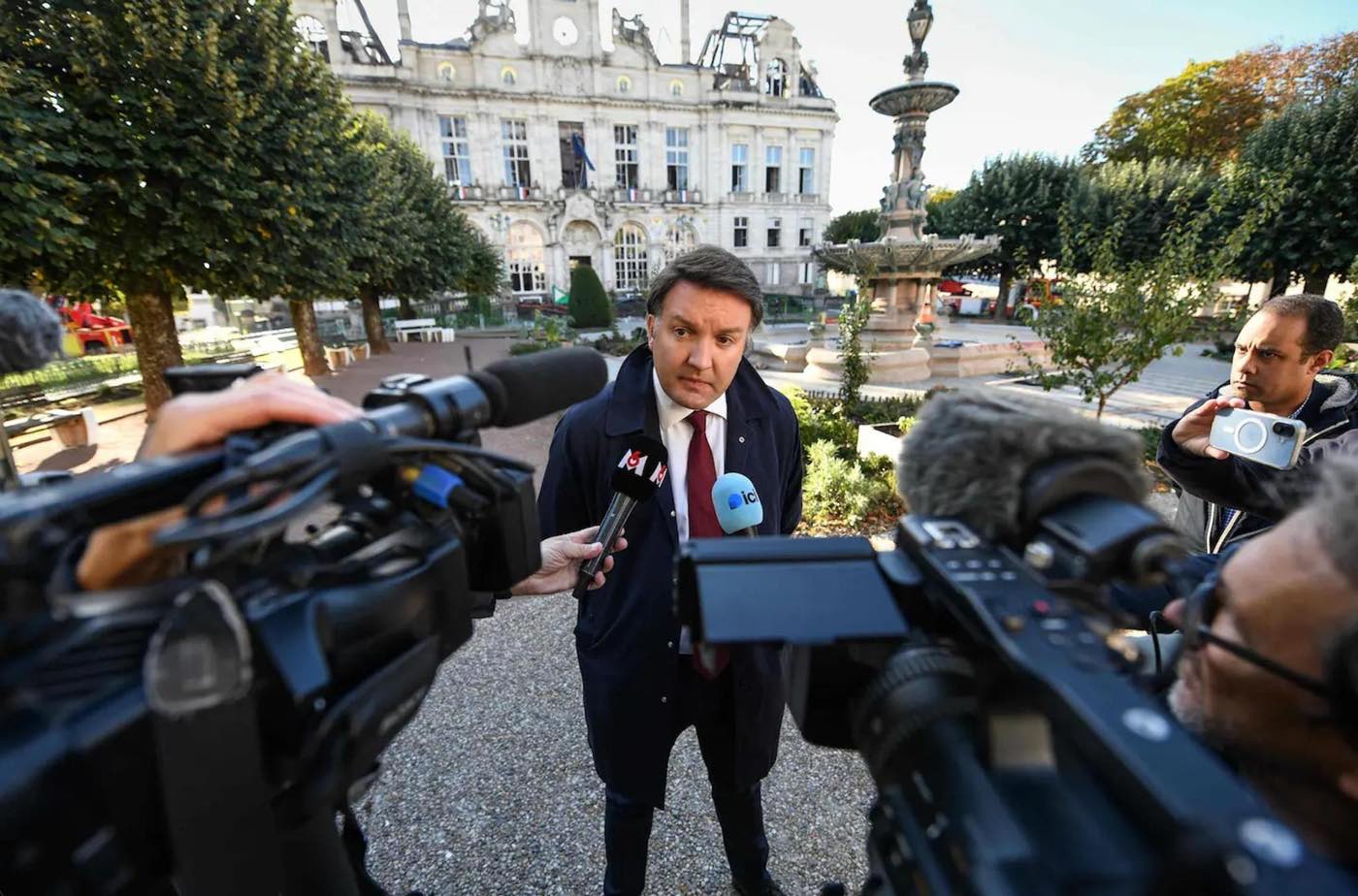
Guillaume Guérin, the right-wing mayor of Limoges, during the press conference following the arson that burned the City Hall to the ground (Limoges, October 18).
The concept of the ultra-left gained traction within the French mainstream political discourse back in 2008, when the state launched its ultimately unsuccessful terrorism prosecution in the Tarnac case. This concept lumps together all individuals considered by mainstream political forces to be on the left side of the radical left, from anti-statist communists and autonomists to anarchists. After the riots of October 17, anarchists and other rebels are once again in the crosshairs of the authorities and intelligence services. A couple of days later, several individuals were arrested in connection with the arson of the Limoges City Hall. So far, a 34-year-old individual linked to anarchist and radical environment circles has been indicted on three charges: “destruction as part of an organized group,” “criminal conspiracy,” and “attempted murder of a person holding public authority.”
Mayors from various cities announced that they would gather in front of city halls on Monday October 20 in defense of the French Republic and its institutions and to show support to all the “victims” of property destruction. During these so-called apolitical events, conservative politicians and defenders of the status quo assembled, and far-right activists in cities such as Lyon took the opportunity to spread their messages.
The Streets Attempt to Keep the Riots Alive
On Sunday afternoon, some determined and courageous individuals decided to push forward and riot anew in different cities. In Paris, small groups of protesters started to converge at Place de la République, but the unauthorized gathering faced an assault by police forces with tear gas canisters and stun grenades. Groups of rioters dispersed and spread through neighboring streets, creating confusion and increasing tensions in the area.
At the Quai de Valmy, near the canal Saint-Martin, people built makeshift barricades with self-service rental bikes before setting them on fire. Police forces arriving to “secure” the street were met by hostile protesters screaming, “ACAB.” In nearby Beaurepaire street, groups of young rioters looted a clothing store in front of awed bystanders who were simply enjoying a quiet sunny Sunday afternoon. Sporadic clashes with law enforcement continued until late at night, as groups of rioters sought still untouched targets in the République and Châtelet-Les Halles districts but struggled to build momentum with reduced numbers amidst the heavy police presence.
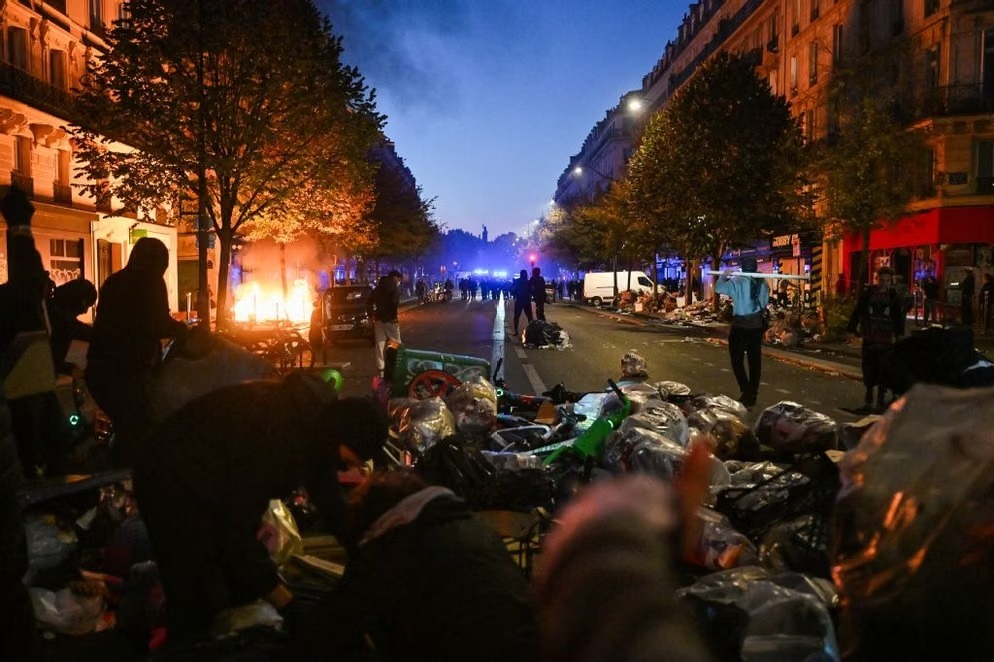
A makeshift barricade near République during the attempt to continue the riots on October 18.
To prevent additional riots in the République district, authorities summoned a specialized police unit focused on riots, looting, and property destruction. The CRS 8, as this special squad is known, was created in 2021 and can field 200 officers for the Paris region. In the years since, four additional units have been created across France, and can be called upon 24 hours a day, 7 days a week. It is not a secret that this special riot police force is often accused of extreme violence against rioters.
The State Attempts to Regain Control
On Sunday night, President Emmanuel Macron addressed the nation on national television regarding the weekend’s events. In his 10-minute official speech, he refused any responsibility on the part of the government for the current social and political situation. Deploying familiar double-speak, he explained that even if concerns over the unbearable increase in the cost of living may be legitimate, the behaviors of some protesters on Saturday were simply unacceptable. He insisted that those who committed acts of violence would be punished, singling out “factions from the ultra-left” and other “delinquents.” In another attempt to pacify the situation by undermining the movement, he concluded his speech by calling for more dialogue and insisting on the absolute need to respect the Republic and its institutions, especially during the upcoming Presidential elections.
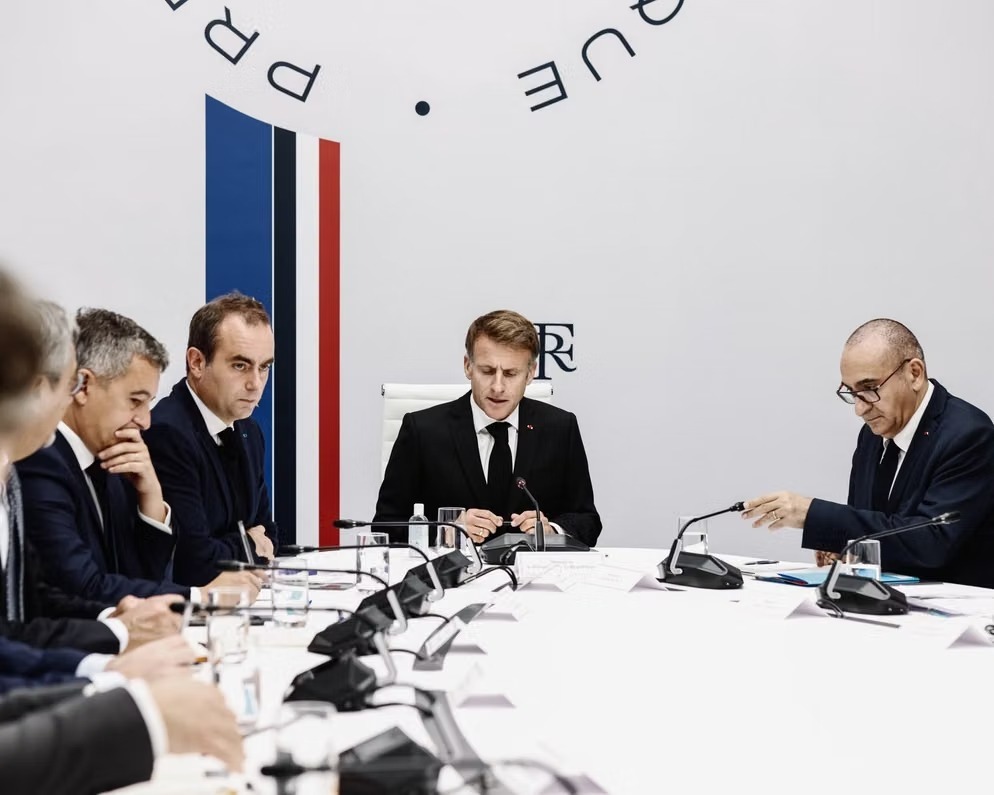
The day after the nationwide insurrection, the government organized a crisis meeting at the Élysée. From left to right: Gerald Darmanin (Minister of Justice), Sébastien Lecornu (Prime Minister), Emmanuel Macron (President), and Laurent Nuñez (Interior Minister).
Reports surfaced that earlier in the day, Interior Minister Laurent Nuñez had submitted his resignation, but the president refused to accept it in hopes of avoiding further confusion and instability. The government also admitted its “colossal failure” in ensuring public safety and order during the weekend, as intelligence services and local authorities had completely underestimated the insurrectionary potential within the day’s call to action.
The government undertook drastic measures to reassert their control. Although declining to implement a national state of emergency, Prime Minister Sébastien Lecornu announced that local authorities would be able to implement partial curfews if deemed necessary to restore public order. On Monday night, several cities decided to use this political tool to restrain people’s freedom of movement, and more cities are expected to follow suit in the coming days.
In Paris, the curfew imposed by local authorities banned all gatherings and demonstrations from 8:00 pm to 6:00 am in the following districts: République, Châtelet, the entire Île de la Cité, Place de la Bastille, Place d’Italie, Place de la Bourse, all the Parisian train stations, as well as the areas surrounding official buildings such as Matignon, the Élysée, the Senate and the Assemblée Nationale. To assist law enforcement units on the ground, a police helicopter circled over these areas every night to detect potential groups of rioters. These draconian measures allowed authorities to successfully contain, if not fully suppress, the collective rage smoldering in the cities.
Return of the Yellow Vests, Act II: October 24, 2026
In the aftermath of the first successful act of the newly reborn Yellow Vest movement, some organizers decided to use the same strategy they had in 2018, calling for another national day of action the following weekend. This time, however, the government decided to take this call seriously and changed its law enforcement doctrine. Indeed, Prime Minister Lecornu explained that on October 24, police operations would be “massive,” with approximately 80,000 police officers and gendarmes deployed throughout France—an increase of 20,000 more officers than the previous weekend.
Interior Minister Nuñez defined the new objective for law enforcement as remaining “reactive and very mobile.” Accordingly, he announced the deployment of elite police units such as the GIGN (the National Gendarmerie Intervention Group), the BRI (the anti-gang Search and Intervention Brigade), and the RAID, reinforced by helicopters, water cannons, and armored vehicles.
Moreover, the French government also announced that military troops of Opération Sentinelle would also be mobilized to secure certain official buildings so police forces and gendarmes can focus on law enforcement operations. The decision mirrored Italian Prime Minister Georgia Meloni’s decision to send 500 soldiers to Milan after riots and lootings following recent protests against the cost of living. Opération Sentinelle is the name given to a military counterterrorism operation launched in 2016 aimed at strengthening the protection of French citizens, using military resources (personnel and equipment) and drawing on military expertise, alongside domestic security forces. Under this program, about 10,000 soldiers are deployed throughout French territory today.
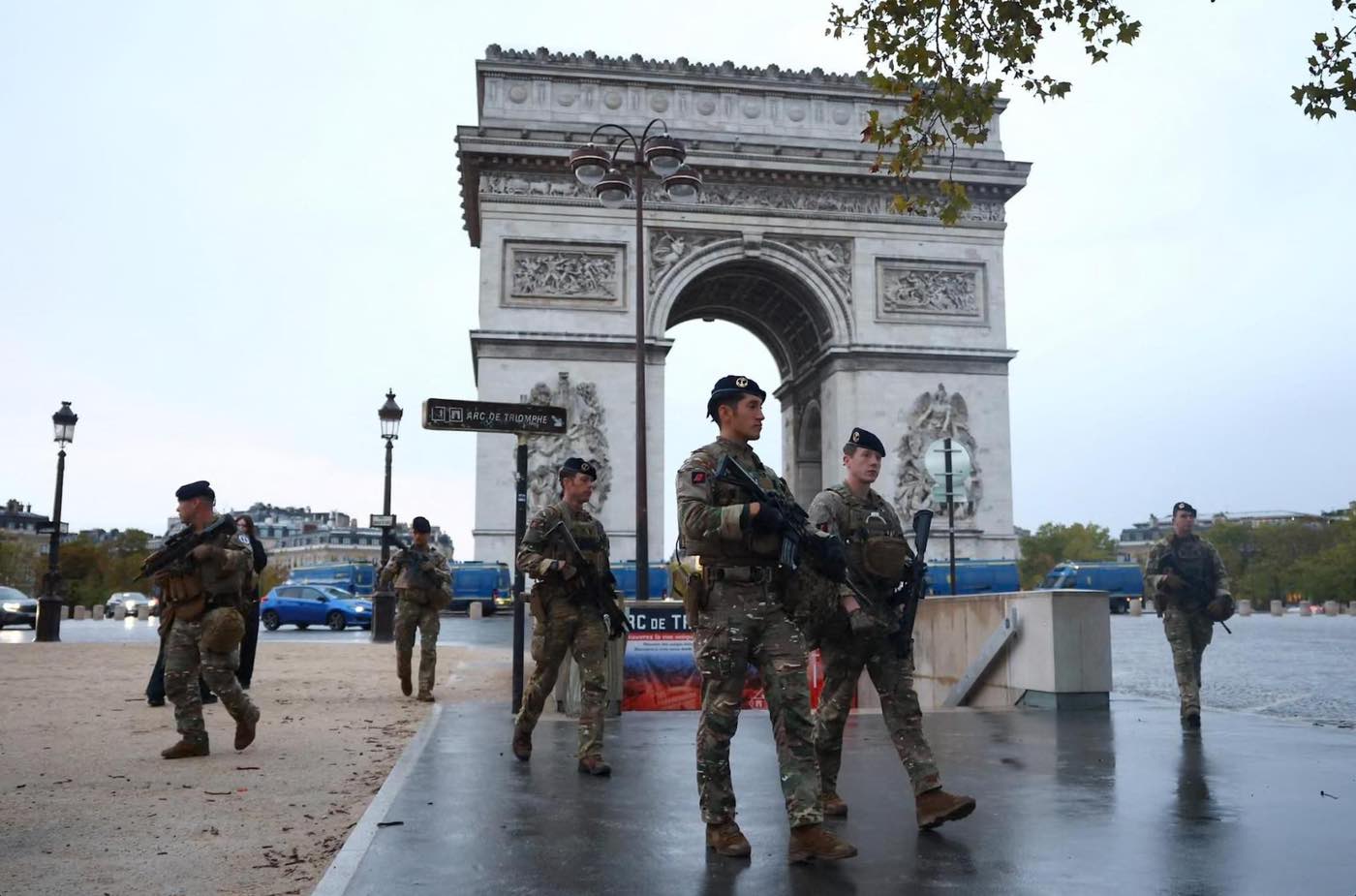
Military forces of Opération Sentinelle deployed to secure official buildings in Paris, on October 24.
On the eve of the second act of the reborn Yellow Vests, the Paris Police Prefecture announced that the initial itinerary of the afternoon demonstration connecting Bastille to Nation was now cancelled. Instead, they proposed a new route outside downtown Paris, between Porte d’Italie and Porte de Vincennes. By doing this, authorities aimed to isolate demonstrators from potential targets. Nevertheless, trade unions and organizers refused this last-minute change of plan, declaring that they would still spread the word to gather at Place de la Bastille the following day.
Early on the morning of Saturday, October 24, police forces had already converged near Place de la Bastille to prevent crowds from gathering. Groups of demonstrators were dispersed, and organizers ultimately resigned themselves to the alternative 5.5 km route imposed by the Prefecture. The procession gathered a variety of different profiles: students, Yellow Vesters, trade unionists, political activists, families, radicals, and so on. In the end, 250,000 people joined the quiet procession in Paris according to activists, or 110,000 according to the Interior Ministry. Only a few clashes erupted between protesters and police forces at the end of the march near Porte de Vincennes and Nation in an otherwise restrained march.
Other demonstrations took place in Marseille, Lyon, Bordeaux, Toulouse, Grenoble, Rennes, and Strasbourg. Some confrontations with police and property destruction took place towards the end of these actions. But overall, police forces managed to keep the situation under control, with only 75 fires and 24 stores looted across the entire country. The government succeeded in containing potential rioters in part through large numbers of arrests, totaling 1314 over the course of the day. Afterwards, Nuñez could state that “all processions went well,” acknowledging a total of 410,000 people across France at the demonstrations—800,000 according to political organizations. This second act produced totally different atmosphere in the streets from the weekend before.
While the protests were notably muted during this round, violence from police continued. Mainstream media reported serious injuries to least three individuals during street confrontations, including one protester in Toulouse and another in Clermont-Ferrand with injured hands from stun grenades and one protester in Poitier suffering from an eye injury.
As hundreds of thousands demonstrated against the rising cost of living throughout France, other protesters gathered in Orléans to protest the presence of the National Rally at their first presidential campaign meeting. 3000 police officers patrolled the streets for the occasion while the city barricaded itself in fear of potential street confrontations. Ultimately, the anti-fascist march attracted somewhere between 13,000 and 26,000 people, depending on which political side is counting the number of demonstrators. Actions against the National Rally and their followers continued during Sunday, October 25, despite the ban on gathering in the streets.
Epilogue: This is Not Over Yet
While writing these final lines, it is difficult to predict what might come next. The level of intensity and determination present in a social movement can fluctuate from one week to another without necessarily indicating a loss of momentum. We hope that this will prove to be the case here, as this new wave of Yellow Vest protests builds on the energy of the student unrest. The less intense actions of October 24 may allow protesters to reinvent themselves and broaden their strategies for future calls.
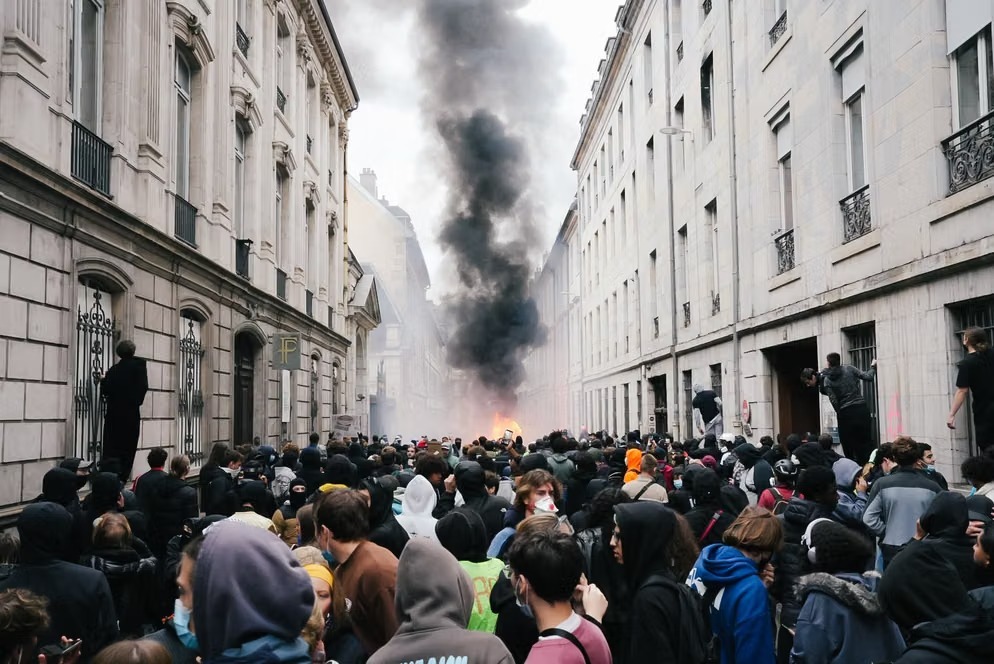
Joyful demonstration in the streets of Besançon (October 17).
One factor that will shape the next weeks of the struggles is the nation’s academic calendar. Since October 17, high school students have officially been on break, and will remain so until Monday, November 2. As a result, students haven’t been able to carry out actions in front of their schools, since they are closed. So far, the student movement as it emerged several weeks ago is on hold, and no one can predict whether it will be able to regain momentum after the break.
However, the student mobilization is continuing under new forms, mostly through initiatives carried out by university students. For example, on Monday, October 19, groups successfully blockaded different entrances to the Louvre museum for hours in solidarity with high school students and with the ongoing movement against the rising cost of living. This resourceful action shows that even when a movement appears to be slowing down, it is possible to keep it alive through different actions on a local scale.
Further mobilizations are scheduled to take place in the days ahead. As we go to press, Yellow Vesters have called for a day of actions on Saturday, October 31. They have proposed a march route from Place de la Bastille to Place de la Concorde, passing through Opéra, and have threatened to file a complaint if the Paris Prefecture refuses the route or forbids the march. Moreover, political organizations and trade unions are already planning another national mobilization against the cost of living on Thursday, November 5. Student organizations have announced that they plan to join these demonstrations as well. It remains to be seen whether large numbers of people will also respond to these calls to maintain pressure on the ruling order.
What is certain is that the political developments over the last weeks in France form part of a larger wave of social discontent that is spreading like wildfire throughout different European countries. The increasing costs of living have become a central worry for millions of individuals across cultural and national borders, catalyzing collective rage against neoliberal capitalism and government policies. In Spain, struggles against gentrification and evictions have raged for months, while intense protests against the cost of living have erupted in Portugal, Albania, Belgium and Italy. With politicians unwilling or unable to address the root causes of these miseries in a capitalist economy that rewards greed while driving the planet to the brink of environmental collapse, we can be certain that these protests will not fade away soon.
These waves of riots serve as living proof that we are not alone and that possibilities always exist to create breaches within their power. The fight against their world is far from over, but the rage still remains alive and intact within many of us. Let’s burn their world to the ground!
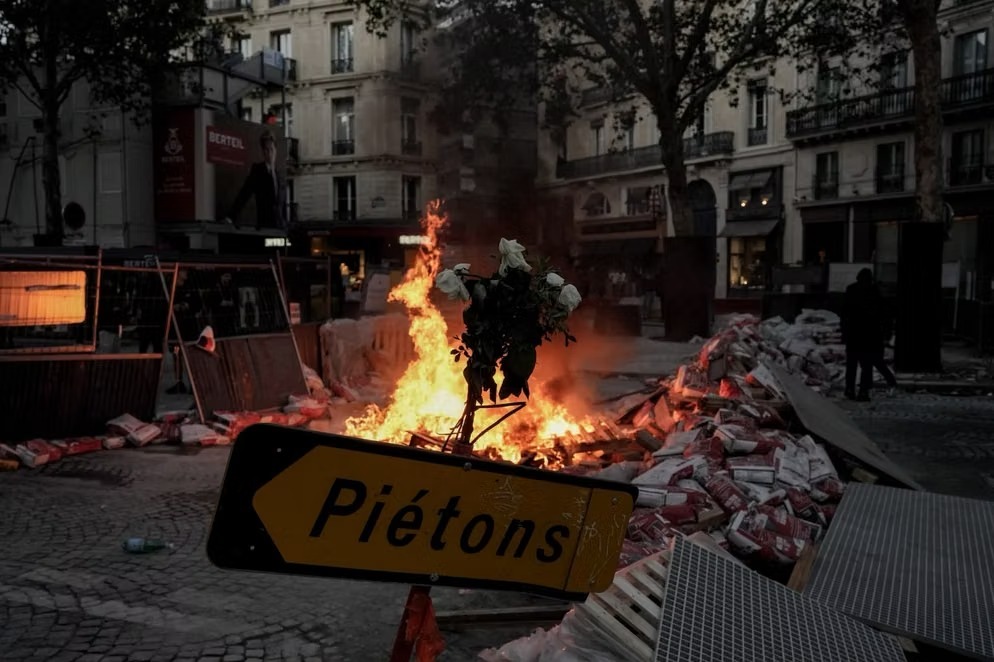
Barricades on fire in the streets of Paris (October 17).