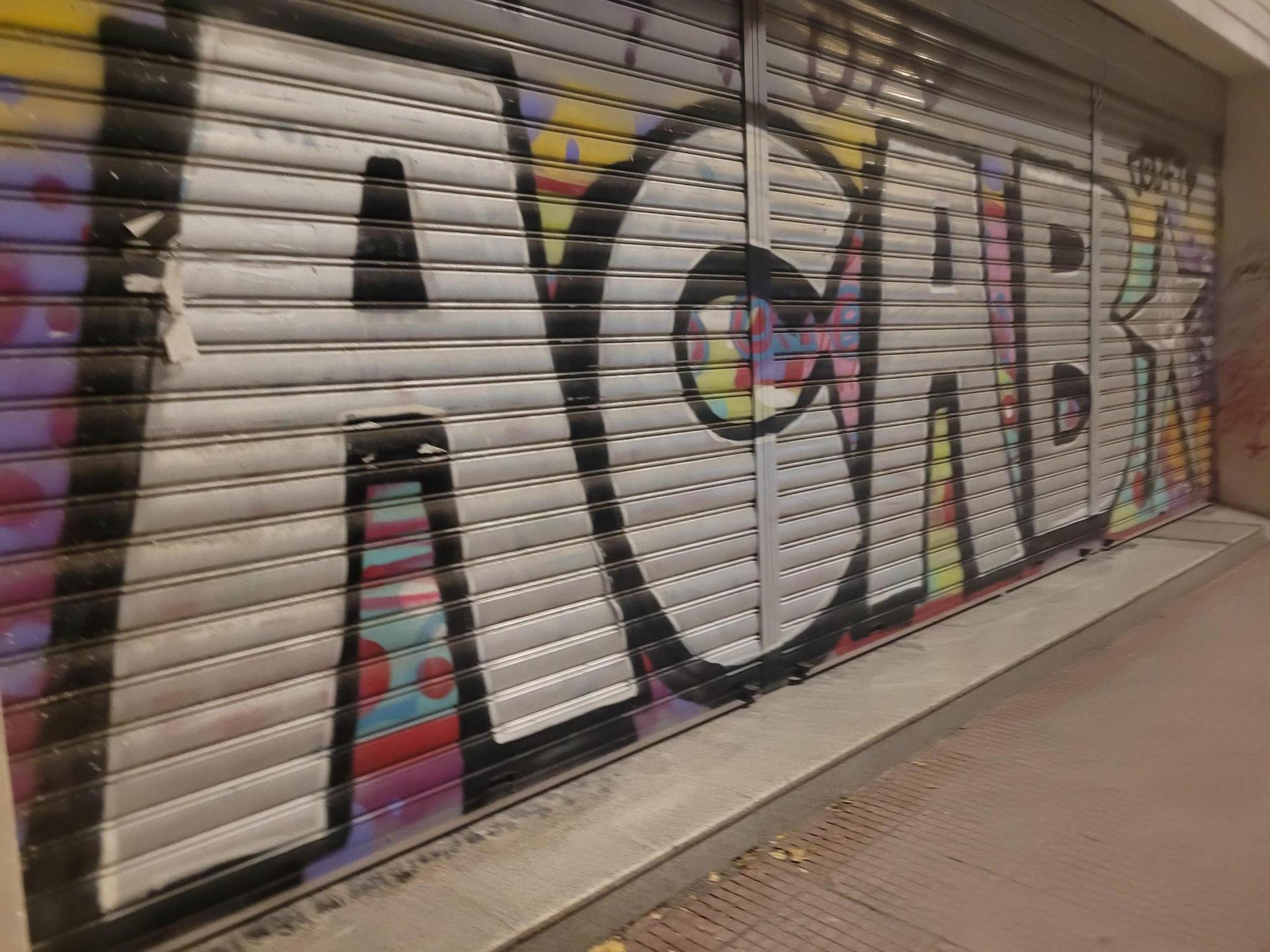
The anarchist movement in Greece faces a new wave of repression. Urged on by the US and its obsession with combatting “far-left extremism,” the Greek state has targeted anti-authoritarians with new legal charges and attacked demonstrations, while fascists carry out street attacks and plot their return to the halls of power. Amidst a landscape of ongoing austerity, terrorism designations, lethal prisons, and ferocious wildfires, anarchists nonetheless continue to forge a combative culture of revolutionary solidarity.
In this article, we present an interview with an anarchist comrade in Athens assessing the current situation among anarchists and anti-fascists in Greece, along with analysis of US’s role in advancing state repression and fantasies of Western supremacy.
The US and Greece: A Right-Wing Alliance to Defend “The West”
Earlier this month, US Secretary of State Marco Rubio delivered a speech at the Pnyx in Athens. With the historic Acropolis and the Parthenon—that ancient symbol of Western democracy, constructed with slave labor—in the background, he delivered a warning message to Greece’s political and business elite.
“The course we take will determine whether the West maintains its place at the head of the world or resigns itself to a future of atrophy and servitude and decline,” Rubio cautioned. “We will either choose to act now or lose the choice to act at all.” Lamenting how “nationalism became a dirty word,” he called for renewed militarism, praised Christian faith and martyrdom, and announced a new counterterrorism information-sharing program between the two countries. His statements were calculated to reinforce the colonial legacy of Western dominance over the rest of the world, while urging the worst of Greek society to imitate America’s current political trajectory.
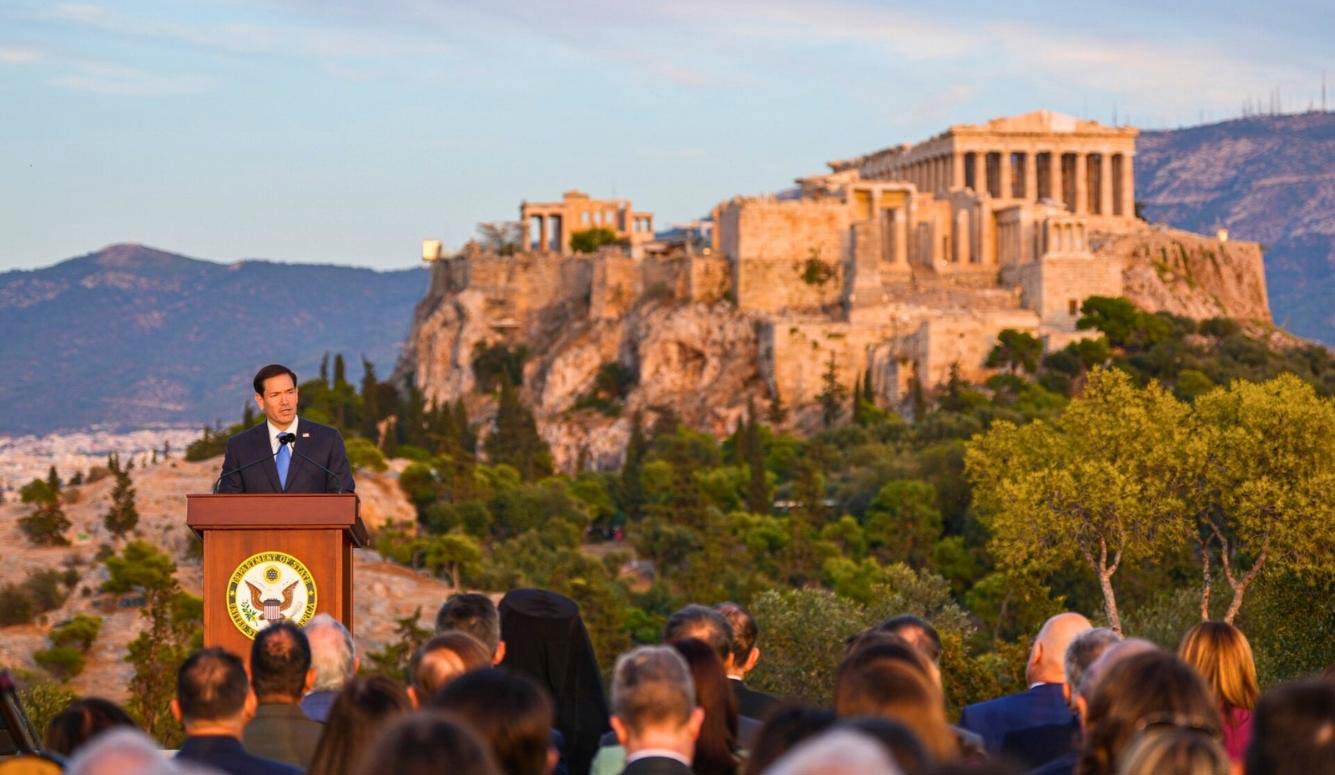
US Secretary of State Marco Rubio constructs an elaborate photo op for his defense of nationalism, militarism, and “the West” (October 7, 2026).
The speech came in the wake of a conference Rubio convened in July that aimed to coordinate intensified repression against “far-left extremism.” The following month, the US government imposed a “global terrorist” designation on the Italy-based Autistici/Inventati (A/I) tech collective, which operated the free publishing platform NoBlogs.org.
Greece’s right-wing politicians and business leaders benefiting from the country’s endless austerity measures are heeding Rubio’s call to preserve the hubris of the so-called West. Meanwhile, governments are collaborating to escalate repression against any truly revolutionary movements that challenge the world’s current status quo.
Greece’s strategic importance to Western powers is rooted in its symbolic status as the birthplace of “Western Civilization,” as well as its strategic location in the world today. The country offers the US access to four military sites, including a dedicated Navy base in Crete’s Souda Bay. Those with a longer memory have not forgotten how the US supplied napalm to Greece’s fascist forces, who worked with the Nazis during World War II and later with the British and US in a Cold War anti-communist alliance. Fascists dropped American napalm on Greek partisan resistance fighters during the civil war from 1946 to 1949, scorching bodies and charring forests, leaving the countryside scarred to this day.
More recently, the Greek people were pummeled by the 2008 global economic crisis, brought on in part by Wall Street firms such as Goldman Sachs that raked in immense profits while destabilizing the world’s economy and immiserating millions. The US then contributed to the austerity measures imposed on Greece in 2010 by the International Monetary Fund (IMF), leading to years of ferocious resistance to neoliberal capitalism and government complicity.
Today, Greece’s current New Democracy regime upholds the legacy of the brutal military junta of 1967-1974, promoting the image of Greece as a symbol European supremacy as invoked by Rubio. Despite its nationalist rhetoric, the government continues to lick the boots of the US, crushing opposition in the streets and enforcing a never-ending precarity on the majority of Greece’s increasingly exhausted and numb population.
This continuing legacy of US imperial arrogance and Greek state complicity can reach the point of absurdity. Recently, the US Ambassador to Greece, Kimberly Guilfoyle, resigned following allegations of soliciting bribes—in the form of paying off credit card debt—from a wealthy Republican donor in exchange for promises to leverage her connections to the Trump family. One cannot ignore the hilarity of Greece’s elite lining up to lick the boots of this comically incompetent and corrupt American official.
The US Rages as an Anarchist Goes Free
However, before her resignation, Guilfoyle commented on the release of anarchist Nikos Maziotis after serving 14 years in prison, saying people like him “have no place in civilized society.” Maziotis was a member of Revolutionary Struggle, an armed guerrilla group listed as a foreign terrorist organization by the United States, and was arrested in 2014 while on the run following a shootout with police.
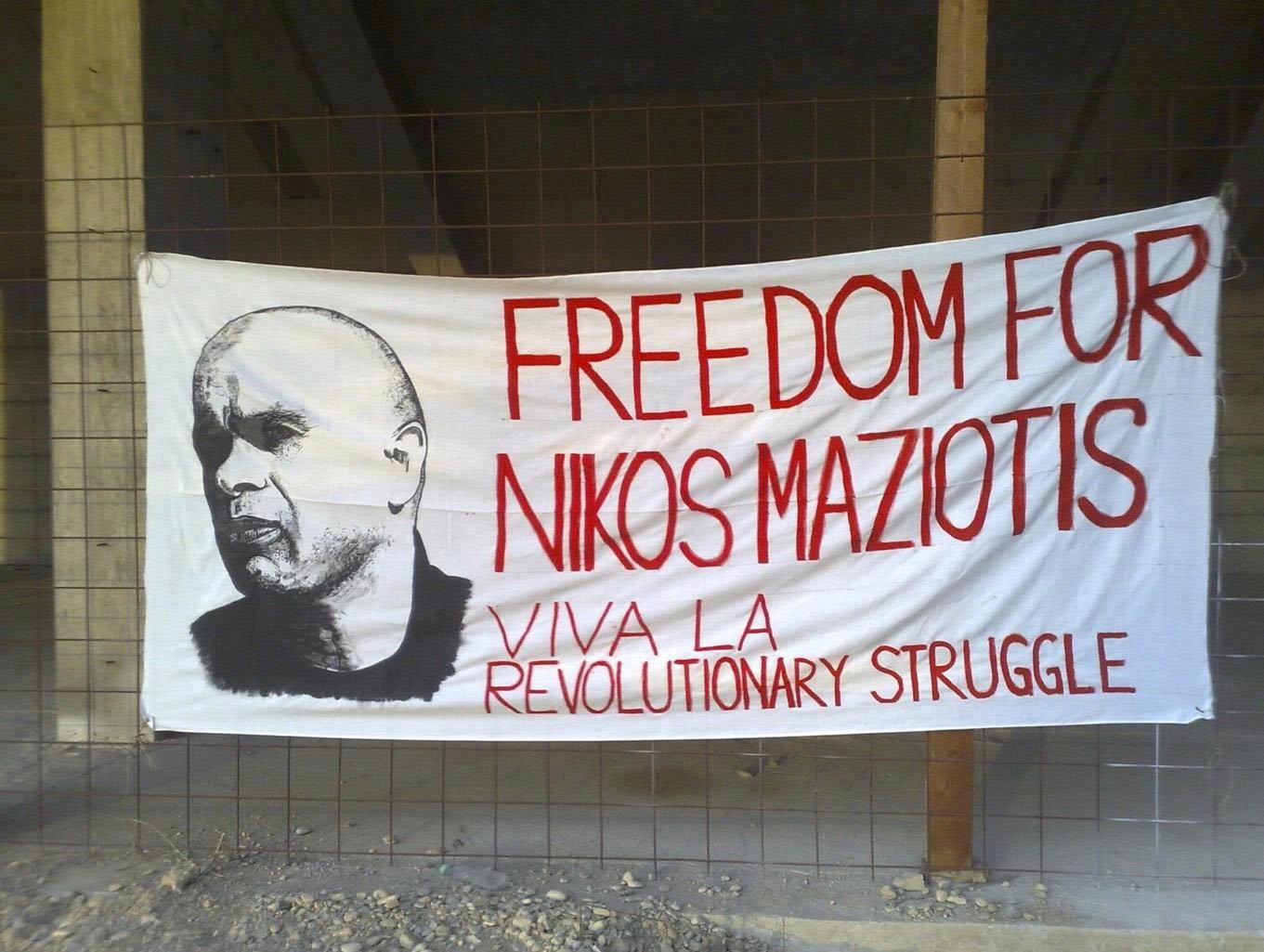
Banner in solidarity with Revolutionary Struggle prisoner Nikos Maziotis, just released from prison in September 2026.
Revolutionary Struggle emerged around 2003 after multiple attacks on the Evelpidon courthouse in Athens. They are also well known for an attack on the Athens Stock Exchange in 2009. Maziotis remained an uncompromising revolutionary while imprisoned. His co-defendant and partner Pola Roupa attempted unsuccessfully to free him from prison in 2016 by hijacking a helicopter. Shortly before his release in September, Maziotis released a statement in which he affirmed:
I would not change my political and activist choices in the slightest, even if I could turn back time.
From the bottom of my heart, I thank all my comrades, everyone who stood in solidarity with us in any way over all these years, with us, the members of Revolutionary Struggle, who remained faithful to the choices of struggle we made.
NO RECONSIDERATION, NO REPENTANCE
LONG LIVE REVOLUTIONARY STRUGGLE
HONOR FOREVER TO COMRADE LAMBROS FOUNTAS
—Nikos Maziotis, Domokos Prison, September 2, 2026
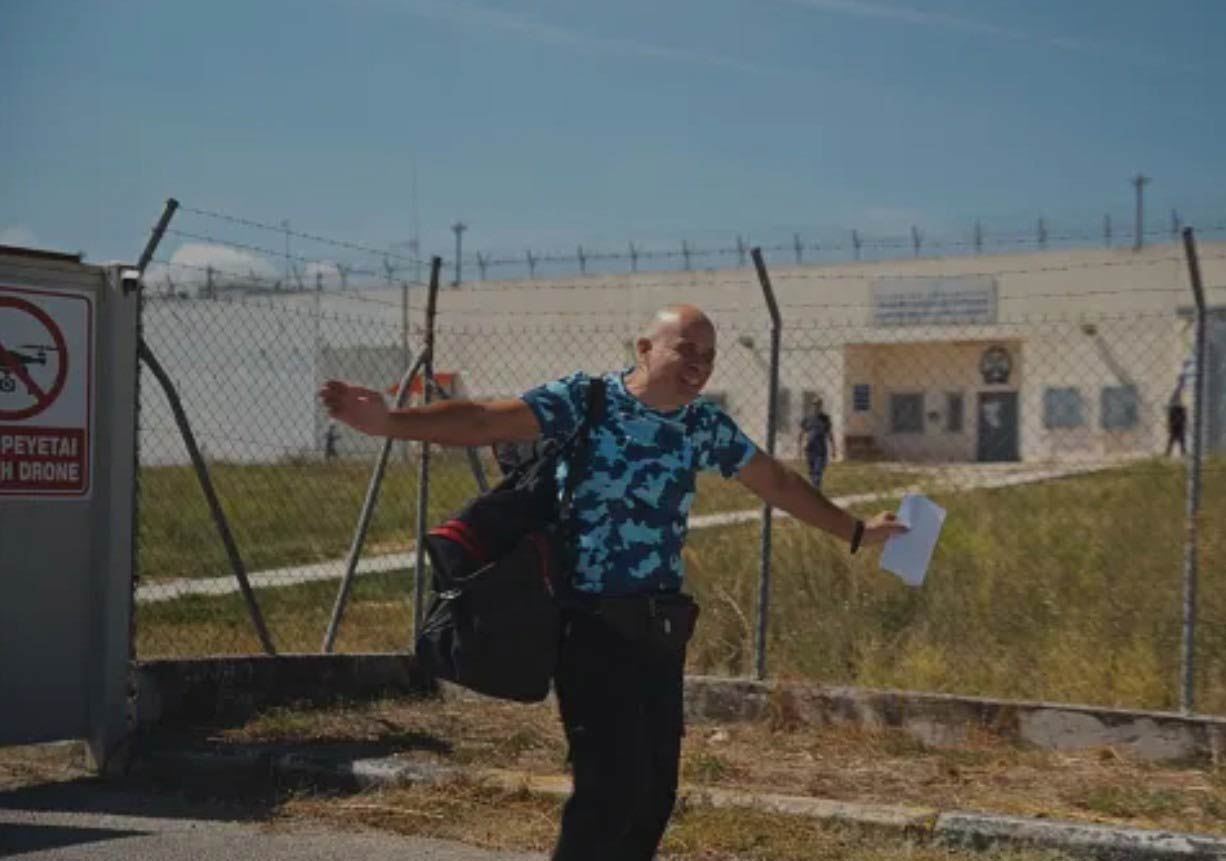
Nikos Maziotis emerges from prison after 14 years into the arms of his comrades (September 2026). You can watch the video of his release here.
The Resurgence of the Extreme Right
Maziotis’s release happened just one day before the release of convicted neo-Nazi and Golden Dawn leader Ilias Kasidiaris, who served just six years of his thirteen-and-a-half-year sentence for leading a “criminal organization.” His conviction stemmed from a token prosecution to calm anger over the murder of anti-fascist rapper Killah P (Pavlos Fyssas) by a Golden Dawn member.
Guilfoyle, of course, condemned only Maziotis’s release, remaining silent about Kasidiaris. That is no coincidence. And the Greek state will certainly try to compensate for his obligatory release by furthering its assault on the anarchist movement and other revolutionary struggles—no pun intended—in Greece.
Upon his release, Kasidiaris stated his intention to immediately resume his political activity. Whether or not he ends up back in Parliament, he will undoubtedly be a force behind Greece’s right wing in the streets, and a more subtle but tangible influence on those in the halls of power. At present, he is unable to restart his neo-Nazi organizing in Parliament under the banner of Golden Dawn without a court ruling to reverse their designation as a criminal organization and to allow them on the ballot. But he intends to start a new organization with the same goals under a different name. Similarly to Marine Le Pen in France with National Rally, he is attempting to clean up his reputation and pursue a more mainstream approach to achieving his fascist aims. His legacy continues to inspire right-wing youth, even though violent street actions must not be connected to him while he seeks political legitimacy and another career in Parliament.
His release has emboldened Greece’s institutional and grassroots fascist forces. Like Zionist settlers in the West Bank, groups such as the Golden Dawn enjoy the support of country’s police and military. This allows them to minimize risk when attacking immigrants, refugees, anti-fascists, anarchists, and other targeted groups. They often imitate the aesthetics of anti-fascists and anarchists, dressing in black and claiming to be “rebels” (like Americans who idolize the Confederate past). Yet their “rebellion” is mere cowardly cosplay, consisting primarily of attacking migrants, homeless people, squats, and other vulnerable individuals. They undertake their violence secure in the knowledge that it would require headlines and widespread discontent to prompt anything nearing the level of repression that anarchists and actual revolutionary groups face. Only when the Golden Dawn killed Killah P, a Greek man, did the state finally crack down on them; and despite their convictions, many have now been released and are free to continue their fascist organizing.
Neo-Nazis have been emboldened since the release of Kasidiaris, exemplified by the attack on a known anti-fascist walking his dog by two young fascists in the neighborhood of Elefsina, just a bit outside of Athens. The two youths approached their target screaming, “You are a leftist and we are fascists.” The anti-fascist succeeded in defending himself, humiliating the two youths who surprised him in the street. However, upon realizing that they couldn’t beat him, the cowards stabbed him in the thigh, hitting a critical artery. Fortunately, the anti-fascist was brought to the hospital and survived his wounds.
A massive anti-fascist demonstration happened in the neighborhood after the attack. It faced no grassroots opposition, but the uniformed opposition massed nearby with officers ready to pounce if given the order. The media at first immediately dismissed the attack as standard hooligan-on-hooligan violence, refusing to recognize the pervasive fascist influence Golden Dawn continues to exert in Greece to this day. It took a widespread outcry, multiple demonstrations, and the discovery by police of fascist paraphernalia in the two youths’ house, including an “Autonomous Nationalist Youth of Athens” sticker, for the state to admit that this was an attack by fascists influenced by the legacy of Kasidiaris’ Golden Dawn. Anti-fascist sources have established the connection of the two young fascists to the notorious Nazi street action group ProPatria.
Had the anti-fascist been Roma or Pakistani rather than Greek, the attack likely would have been swept under the rug. The ruling New Democracy party refuses to acknowledge the suffering of marginalized peoples who have been assaulted, murdered, trapped by debt into forced labor, kidnapped by the far right in the streets, or faced pogroms and indefinite detention in EU-funded migrant concentration camps across the country. Many such attacks by police and fascists remain unreported, deemed unworthy of recognition by the mainstream nationalist press.
Like the thugs of the military junta fifty years ago, Greece’s nationalists have always been a friend to the country’s ruling class, similar to Trump and his MAGA base in the US today. So neither Guilfoyle’s silence on Kasidiaris’ release nor the designation of Revolutionary Struggle as a terrorist group by the US is a surprise. Neither Rubio, Guilfoyle, nor New Democracy Prime Minister Kyriakos Mitsotakis take issue with political violence. They take issue with political violence aimed at revolutionary change or self-defense against oppression.
At the moment, Greece’s anarchist movement remains in the crosshairs of the Greek state. The movement is adapting to a modernized repression, inflicted to defend a society treated as a zoo for tourists with an educated population ripe for exploitation by customer service and tech firms from wealthier nations. This interview continues our efforts to offer English-language updates on the anarchist movement in Greece from comrades on the ground. Our priority is to develop a concrete understanding of the current situation in Greece, to cultivate resilience and solidarity that transcends borders and prison bars.
Repression and Resistance in Greece Today: Interview with an Anarchist in Athens
The following is an update from a comrade on the ground in Athens, Greece. For further background and context, see our previous coverage on the Solidarity Assembly for Imprisoned Fugitives and Persecuted Combatants (2026), state repression of the refugee struggle (2023), the Greek Wildfires (2021), the state of the anarchist movement at the end of the pandemic lockdown (2021), the state’s ban of the fascist Golden Dawn party (2020), and the right-wing New Democracy party’s crackdown on autonomous movements (2019).
“Our passion for freedom is stronger than any prison cell.”
—Felix Daspitilakis, Anonymous Publishing Union, Athens, 2026
We spoke a few months ago, but for new international readers, could you introduce yourself and the projects you’re involved with?
I participate in the anarchist and anti-authoritarian space in Athens, Greece. I am involved in various open assemblies organized in response to multiple issues, such as solidarity with political prisoners in Greece and internationally, or state repression against the movement here. I also support the movement’s infrastructure, especially organized counter-information and the defense of squats.
Since we last spoke, the international press has widely discussed the recent arrests made sixteen years after the burning of the Marfin bank in 2010, which resulted in the death of three employees who had been forced to work by their bosses despite the unprecedented general strike. Could you explain what brought on these sudden charges, the details of the case, and its implications?
This case concerns the events of the 5th of May of 2010. During a massive, half-a-million-strong demonstration in support of a general strike, the building of the Marfin bank was set on fire and three employees who had been locked inside by the management died. This triggered a massive retaliatory repression attack by the state, both against the demonstration on the day of the strike and over the following days and years against the broader movement.
It is clear that the anti-memorandum movement of 2009-2015 [a series of protests against government austerity measures, including pension and salary cuts and higher taxes, imposed by the International Monetary Fund] had seriously threatened the Greek state. Masses of people participated in protests, massive general strikes and numerous clashes with police took place, and the belief that there is an alternative to the politics of the Greek state, the EU and the IMF became widespread. This remains an open wound for those in power. And although in the end this turned out to be political capital that the SYRIZA (a left-wing party in power from 2015 to 2019, known for its broken promises) government expended without achieving anything, the state wants to have the last word about this historical period.
This is especially true for the right-wing of this country. The Marfin bank arson offered them an opening to attempt to recover a moral high ground. Over the years since it happened, the right has consistently invoked it to elicit declarations of democratic submission from the left, almost with the same intensity as with the shooting of Bakogiannis by the revolutionary organization November 17th group (N17) in 1989.1 And, apart from a few exceptions, the left unfortunately did indeed offer concessions to the right following these events as a result of pressure campaigns arranged by New Democracy and Greece’s right-wing parties.
This is the third time that this case has been reopened. The first round of prosecutions ended in acquittals, while the second round didn’t even result in trials. Until this third attempt to use this tragedy against the anarchist movement, the only conviction was of the owner of the bank for forcing his employers to work on that day of general strike while neglecting fire safety standards and protocols, the main culprit for the death of the three employees.
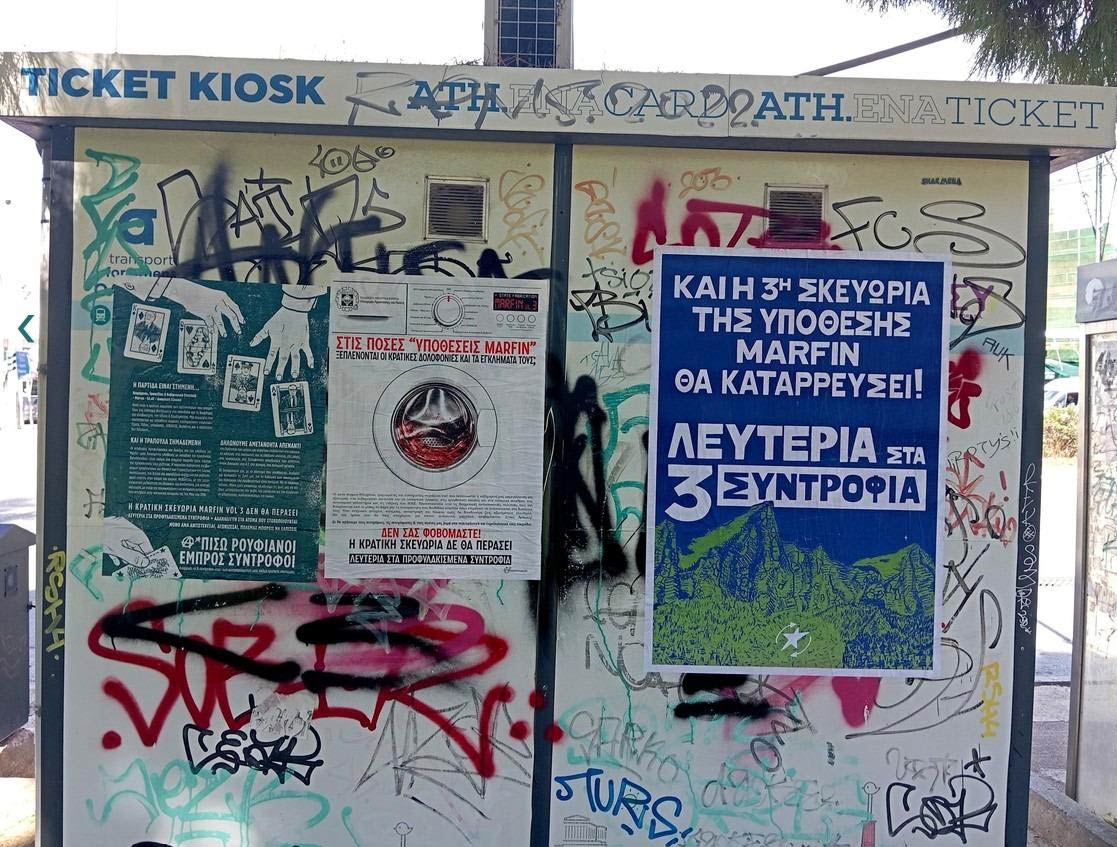
Posters in solidarity with the three anarchists charged in the Marfin bank case.
Now, sixteen years after this tragic event, we face another government scheme that has nothing to do with offering justice to the victims of the fire. The evidence that led to the pre-trial imprisonment of the three arrested anarchists consists of anonymous email, sent sixteen years afterwards. It names random people—one of whom was actually in jail during the event—alongside photos that allegedly identify various individuals, using pictures of people on vacation compared with images of hooded participants in the demo with supposedly similar body types and punk band stickers on bags.
As usual in these cases, the mainstream media advances all kinds of fanciful stories to obscure the total lack of evidence. We read about AI systems that supposedly can magically reconstruct faces from photos of hooded people. The anonymous email is an almost comic attempt to modernize the anonymous phone calls historically used by police and the anti-terrorist unit to falsely incriminate people in earlier cases.
Such theatrics and flimsy evidence give the impression of a case that will again be voided by the first degree court. Nonetheless, even if this turns out to be the case, the state’s effort offers some important lessons.
Most importantly, pre-trial detention can last for up to eighteen months. Apart from the terrible conditions in Greek prisons—many states, including the UK, officially categorize Greek prisons as inhumane—the destructive effects this has on the lives of those arrested is evident.
Furthermore, being falsely accused, tried, and convicted by the media for killing other people imposes a practical and psychological burden that will not be relieved by dismissed charges or acquittal.
Finally, it is clear across all Western states that repression is on the rise on many levels: augmentation and modernization of police, harsher penal codes, etc. Regardless, as a movement, we will organize to put a stop to this persecution of our comrades. But the case shows that the Greek state is once again advancing its attack on revolutionary movements as a whole and against the anarchist space specifically.
To conclude, we should mention a new development which clearly shows the state’s intention with regard to this case. In October, our comrades faced another round of interrogation, concerning a new charge of “atomic/personal” terrorism. This makes the case file even more nonsensical: we now supposedly have three separate and independent terrorists that committed an organized triple murder together, along with multiple other attempted murders of the other employees that were trapped inside the bank by their bosses. Given that a murder conviction carries the heaviest penalty in terms of prison years under the Greek legal system, these additional charges do not add anything substantial in the way of sentencing.
This shift in charges reveals the state’s true intentions. Under Greek law, terrorism charges move a case from a jury court to a court with only “professional” state-appointed career judges, who are under more pressure by the state and have a clear incentive to convict, regardless of the actual evidence or lack thereof.
Prior to the reopening of the Marfin bank case, police made multiple arrests in connection with alleged attacks on Greek politicians’ homes in Salonika. Do you have details on these arrests, their potential use by the Greek state in cracking down harder on the anarchist movement, or their connection to this strange decision to reopen cases from long ago?
The Marfin case was reopened immediately following the Salonika case, making it obvious that the state wanted to use them together to create a strong effect in the media. For the Salonika case, our comrades’ position is that they are being targeted as known anarchists. The state needed to show a strong reaction since during the incident, the mother of a member of the governing New Democracy Party was killed. The government’s rhetoric targets the anarchist and anti-authoritarian movement as a whole. So the appearance of both of these cases at the same time indicates a hardening of the state’s position against us, and an indicator that things will probably get even harder.
How is the anarchist movement currently responding to escalating levels of repression?
The anarchist movement has accumulated many differences and divides over the years. This puts us at a disadvantage during a very difficult period in terms of repression. After each incident, whether it is an eviction of a squat, a fascist attack, or the reopening of the Marfin case we discussed above, the anarchist movement tries to overcome these problems and organize via open assemblies.
Our goal is to claim a portion of the public space with our voices and bodies, to counter the state’s propaganda and defend our comrades and our spaces.
Beyond judicial repression, we have learned about the killing of a boy on the spectrum in Argos, Greece by police. We watched one demonstration against the murder attacked brutally by police. Are police becoming more emboldened to crush demonstrations without concern about public judgment? Does the background of the murdered boy help to explain why they are so emboldened to respond like this?
I think that there has been a shift in the political reality in Greece concerning repression, at least since 2019. First of all, the population of cops is much larger than before. Also, they are one of the few social groups that have continued to receive benefits from the state during these years of extreme economic austerity, making them a loyal and hardened “partisan army” for the government. This, combined with the decline of the left and social movements in general, as well as the extreme rhetoric of the government concerning its repressive ambitions, has given them the signal that they will be protected no matter what they do.
In response to this particular state murder, the current and former mayors of Argos both opted to cover for the cops completely. The government advanced all kinds of half-baked scenarios in the media to support the police’s version of events from day one. The attack on the demonstration follows this reality and the state’s attempt to silence the movement.
It should be noted, though, that the call for the demonstration in Argos and its support by so many comrades marks an important moment for the Greek movement. Despite the fact that it took place in a town largely dominated by right and extreme right-wing politicians, the feeling our comrades got from the people there was not hostile.
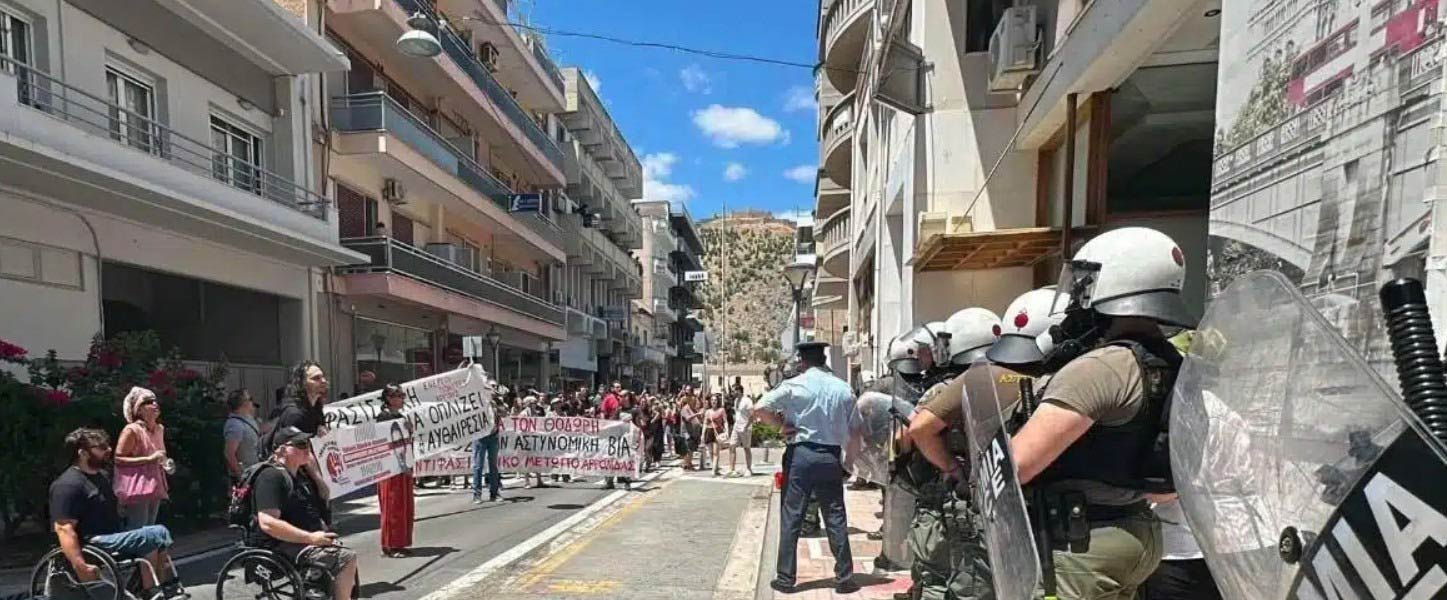
Protestors from disability justice and anarchist movements confront police in Argos (July 25, 2026).
Since we last spoke, have there been any updates on the well-being of Marianna and Dimitra, the anarchists imprisoned in the Ampelokipoi Case, or the arrests related to alleged bank robberies we discussed in the last interview?
For Marianna and Dimitra, who were sentenced to long prison terms for supposed membership in a non-existent terrorist organization, the second-degree court has been arranged for March of 2027. They are both being held in the women’s prison in Thiva and are as well as can be expected given the situation. The same holds for the anarchists who have been pre-detained in prisons all around Greece for the Tithorea bank case. We still have no date for the court until now.
At a gathering of fascist diplomats this July, United States Secretary of State Marco Rubio referenced the alleged attack in Salonika. Do you see these accusations against the anarchist movement as a new opportunity for the Greek state to exploit? Do you think that America’s push for a global war on anti-authoritarian tendencies is catching on with the politicians currently in power in Greece?
The Greek state has historically been responsive to the United States’s demands, especially in matters of repression and anti-terrorism. I am afraid that these statements by Rubio will likely have an impact, at least in the Salonika case. Given the growing pressure the US is exerting in these matters globally, such as labeling “antifa” and Autistici/Inventati (A/I) terrorist organizations, Greece will follow the trend of repression that is now on the rise in most European states.
The Greek state has revised its penal and correctional codes three times since 2019. This has created legal chaos, with lawyers and courts not knowing which law is in effect with each case, and prisons overcrowded with people convicted of low-level offenses. But of course the state is always ready to make things even worse, especially in matters where the US shows a strong interest. We already have government officials talking about extending the maximum prison sentence to 30 years, in response to US pressure over the potential releases of some convicted N17 organization prisoners. According to the current law, their sentences cannot be extended beyond next fall. There is also talk of making it very difficult, or even impossible, to have a prison sentence suspended until the second-degree court makes a decision.
Greece also made international headlines late this summer for its catastrophic wildfires, an ongoing issue in the country that we’ve reported on here. Do you have any comments about that?
These wildfires have unfortunately become normal in Greece over the last decades. The state always approaches this issue as a natural catastrophe that cannot be addressed effectively due to the climate crisis. And the only attention they receive within Greek society, if any at all, focuses narrowly on the loss of human lives and the economic toll from destruction of property.
Even as these extreme wild fires become ordinary in more and more regions, it is clear that the Greek state cannot pretend it has done the bare minimum to address this issue. Typically for this government, all methods for countering wildfires are outdated, when they are not completely ignored. The fire department remains understaffed, and no money has been allocated towards new technologies that are supposed to help.
I would add that it does not take much thinking to realize that capitalist development is behind many of these catastrophes. Regardless of discussions about what is or is not “natural,” it is obvious that the planet has reached a breaking point as a result of human technological advancement. The connection between these fires and capitalism’s extreme exploitation of human and non-human life has been made explicit in the past years.
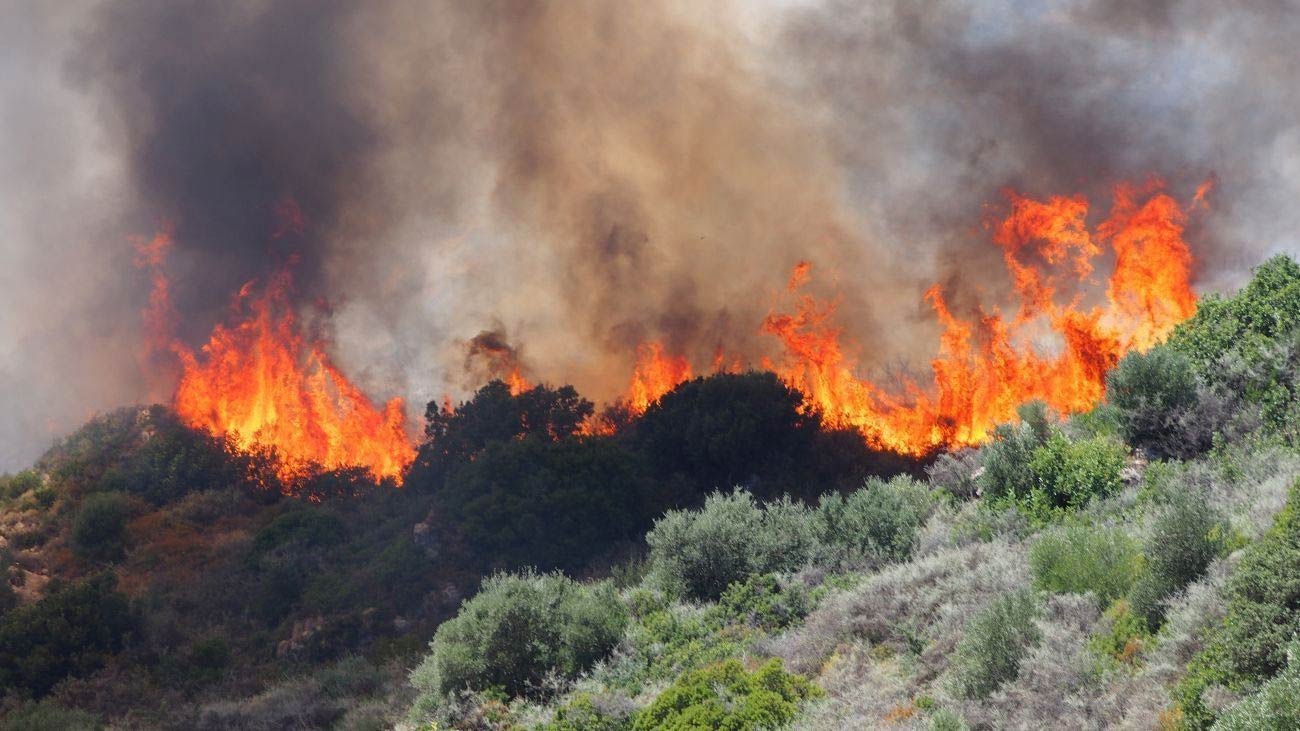
The wildfires that raged through Greece this summer reflect the dire state of a planet ravaged by capitalism.
Considering the extreme heat waves facing the country and the underfunding of prisons in Greece, are prisoners facing harsher conditions than normal? Are prisoners organizing, or are solidarity efforts being organized from the outside?
There have been reports coming in from various prisons about the terrible conditions experienced during the heat waves. In some cases, such as in Domokos prison, water was not even available for prisoners,. There has been one case of a small-scale insurrection in the women’s prison of Thiva, but it appears that nothing is really moving inside or outside of prisons.
Some of the most horrifying conditions exist in the Agios Stefanos prison of Patra, where we’ve seen nine consecutive deaths of prisoners since April of this year. While not directly caused by the heat waves, this horrifying death toll is a direct consequence of the way the prison system in Greece deals with drug users, along with the lack of effective medical care inside prisons. This number was big enough to attract the interest of the media, though the prison attempted to place all the blame on the prisoners and used cops to harass them daily. In the end, popular outrage forced the state to change most of the administration of the prison. Also, the “Solidarity Assembly for Imprisoned, Fugitive and Persecuted Combatants” called a gathering outside the prison on October 12.
I should also mention the recent insurrection of migrants at the closed camp of Sinitiki. The conditions described there, before and especially after the insurrection, are nightmarish. Migrants were reportedly offered nothing but rotten food, when any food at all was available, and insufficient water. People were crowded into cramped containers, with guards who can act as cruelly and violently as they wish, since there is no public oversight. Information about these concentration camps for migrants is scarce, but what we do know reflects the extreme racist violence that is systemic in Greek society.
How can comrades best show solidarity with the movement in Greece?
International solidarity is always the best way for us to support each other. Our struggles and goals are common, whatever our differing circumstances inside the movements are. Each of us fights around the world in solidarity with a common struggle against the state and capitalism. The networks by which money can be sent to support judicial costs are absolutely indispensable, of course. But I would also argue that the strengthening of political relationships internationally could prove to be enormously beneficial for all of us.
Is there anything else you’d like to add?
I would like to state my concern about the A/I closure, after the US government labeled them as a “Specially Designated Global Terrorist” and made it legally compromising to have any official, especially economic, relationship with their services. Terrorist lists have existed for decades now, especially originating from the United States, and have caused various difficulties for individuals who have been accused or convicted under anti-terrorism laws. But this case appears to demonstrate the successful realization of a new strategy for state repression on an international level.
I do not say the above as a criticism to the comrades of A/I for choosing to stop the project. To them I can only express my appreciation for all the years they kept their services open and their efforts to continue while under attack. But given that these states have in a way “socialized” terrorism accusations, and the influence the US has on anti-terrorist legislation in the European states, I am afraid we will see similar repressive moves in the future. Accordingly, we must find ways to deal with them.
The comrades from A/I have already indicated a path I’d also suggest: “Go forth and multiply! May 10 - 100 - 1000 servers spark up.”
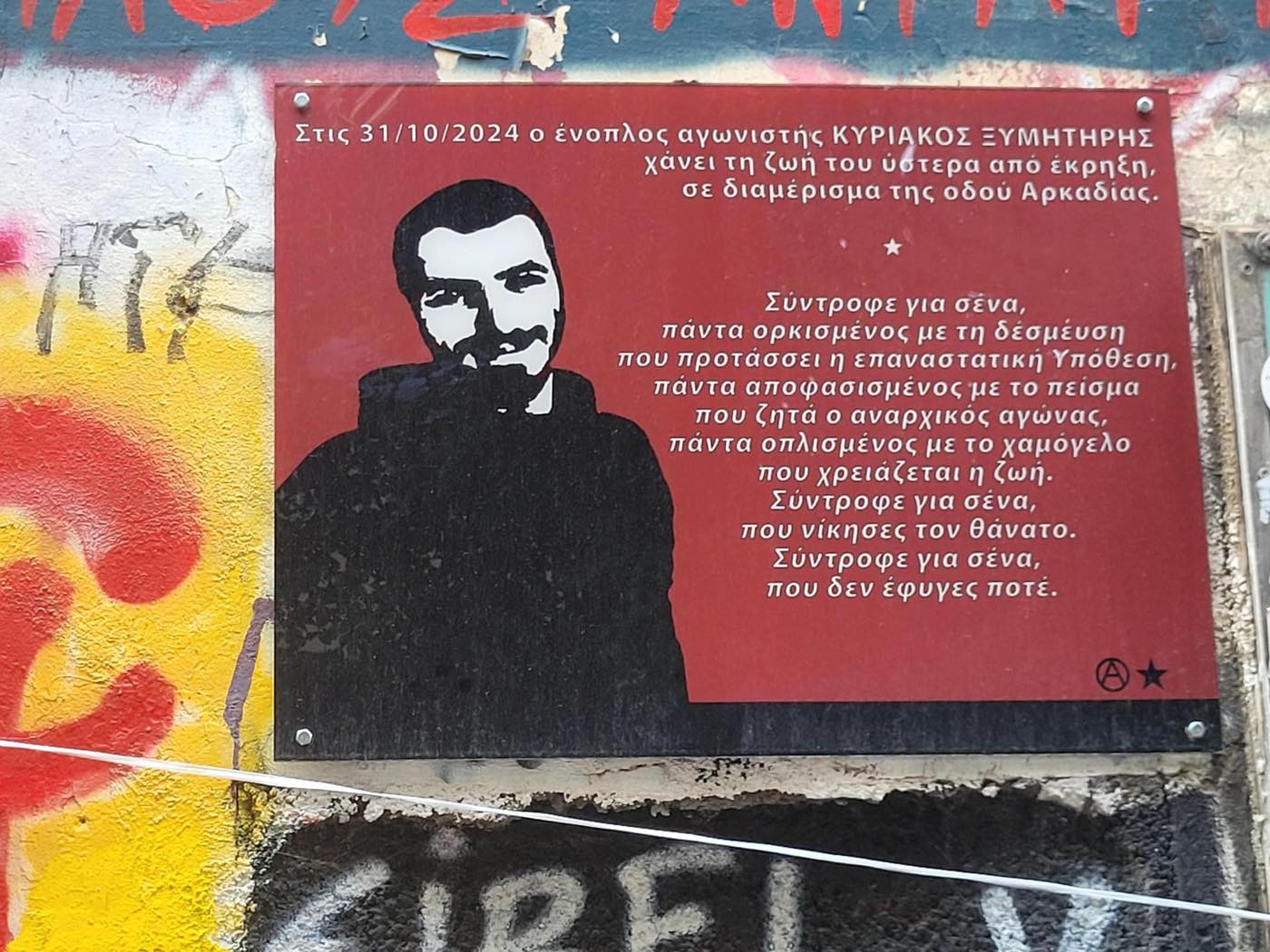
Plaque in Athens commemorating anarchist Kyriakos Ximitiris, whose tragic death in a 2024 explosion led to the Ampelokipoi Case in which Marianna and Dimitra were imprisoned.
How to Support Anarchists in Greece against Repression
The main fund for economic solidarity is Tameio, which provides financial support to political prisoners on a monthly basis. Over the years, it has become one of the most important structures of the anarchist movement in Greece. In addition, there are many specialized funds for specific cases, usually to cover the legal costs of arrested comrades. These funds can be found on websites such as Athens Indymedia and Firefund.
How to Stay Up to Date and Learn More
CrimethInc.’s coverage of the anarchist movement in Greece will continue. Athens Indymedia is the most frequently updated site with relevant information, and can easily be translated using browsers such as Brave.
We also suggest getting a copy of the book Anarchy in Greece: Resistance Reports, published by Active Distribution and Detritus Books. The book includes some articles that have appeared on CrimethInc, plus additional texts by anonymous anarchists on the ground in Greece as well as political prisoners such as Marianna Manoura. Any and all profits from the book go to Tameio.
-
On September 26, 1989, politician Pavlos Bakoyannis of the New Democracy Party was assassinated by members of the Marxist-Leninist guerrilla group Revolutionary Organization 17 November. Founded in 1975, N17 conducted a decades-long campaign against the Greek state and businesses, including at least 23 assassinations and numerous bombings, before the arrests of many group members in 2002. The potential release of some long-term N17 prisoners next year has catalyzed right-wing efforts to expand prison sentences and legal repression even further. ↩